
Not Knowing is a Shared Human Experience: Ebb & Flow with Lucy Steggals

Image: Zoe Maxwell
Lucy Steggals is a London-based Integrative Art Psychotherapist and visual artist. She splits her time between Off Centre, a charity offering therapy for young people aged 16-25, Artist Wellbeing Company, offering therapeutically informed reflective spaces for artists, and as a tutor at IATE. She also has a small private therapy practice both online and in Clapton, London. Lucy was part of a group that created Ebb & Flow, a set of cards that foster the collaborative exchange of knowledge between artists, researchers, people with a lived experience of dementia and their carers. Ebb and Flow was developed as part of UCL’s Trellis, a project that brings together artists, UCL researchers and London communities to co-create work together.
Hi Lucy, can we start by you telling me about how you got into the art therapy space?
Lucy Steggals (LS): I studied Fine Art many years ago and quite quickly ended up working in engaged practice. I made my own work, but more collaboratively with groups of people. When I left art college — I studied sculpture, fine art, and textiles — I worked as a freelance artist for twenty years doing commissions. I worked on a lot of community-based projects in galleries and museums: Hayward, Whitechapel, and many other places. I had my own practice running alongside, but the two became more and more blurred. I then got into bigger commissions working with hospitals or institutions, collaborating with researchers or people with lived experience. About eight years ago, I began to feel people were bringing quite difficult material to me, and I felt under-skilled. I'd been thinking about retraining as an art therapist, so I went back to college for four years, part-time, and trained as an art psychotherapist.
Now I do all of these things in a strange mixture. I'm an art therapist; I work for a youth charity supporting young people aged sixteen to twenty-five; I teach at a psychotherapy college; and I work for an artist wellbeing company that supports reflective, therapeutically informed spaces for artists and theatre practitioners who are working with difficult material. I still run a very small art practice alongside all of that, and these cards are part of it.
You mentioned working in institutions in participatory and community-focused ways. This seems to have naturally led you towards health and mental health. Why do you think that is? Why does participatory work in institutions lead towards health?
LC: It's two different things. You don't become a therapist without a personal narrative. I grew up in Belgium and moved to the UK when I was fifteen. I found it incredibly difficult, but I had a wonderful ceramics teacher who provided an alternative kind of space, a place of safety where I could be myself and express myself. I ended up doing an A-Level in ceramics. Ceramics saved me in some way. I didn't stay with ceramics; I don't have the patience for glazes and kilns, but it enabled me to navigate being in the world. Then, by proxy, I worked with many different and diverse demographics of people in London: young people, dementia care homes, and homeless centres.
I'm not sure it was a deliberate turn toward mental health; it was more that there are so many stories being told in different ways, and there is healing in people telling those stories and sharing their difficult experiences. The dynamic of someone joining a group, being really awkward and uncomfortable, and then the group moving to accept that person and hear their voice is something I’m very interested in. This is called gentle risk, a phrase I’ve borrowed from philosopher and psychoanalyst Anne Durfourmantelle: you're working with a group of people, and collectively you find a soft place to land, and before you know it you've got people who said they can't draw, wandering around doing chalk drawings on the walls in Islington and not caring. Play is a big part of what I do.
I did a commission at Papworth Hospital in Cambridge, working with cystic fibrosis patients, and I've worked in care homes in collaboration with musicians. I did a commission for Wellcome Sanger, working with people with lived experience of cancer. It gradually moved more and more into that area. As an artist, I wanted to be braver with the stories I was asking people to tell, but I didn't feel it was safe. I understand now, retrospectively, how you need to ensure safety and containment before someone can choose if they would like to work collaboratively with their sometimes difficult material. The risks I was taking as an artist without realising I was taking them were an education, but I look back at some of what I did with slight horror, because I just wasn't aware of how delicate those situations were.
An art practice might be really good at opening things up, but an artist isn't necessarily someone trained in closing it back down.
LC: Exactly. You might open something and leave someone in quite a lot of distress. Or you're aware you've opened something, but you don't have the skill set to make them feel safe again. A lot of artists who do that kind of work have a natural intuition that carries them through. It's just that it can be stressful, and more and more people are sharing difficult stories, which makes it risky.
There's a context question too. If someone's coming to a workshop in a particular institution, being opened up in that way may not be what they're there for.
LC: You’re an artist; you're being explicit about that, and it's not an artist's responsibility to contain someone's emotions. But it happens, and having sensitivity to it is really important. I wanted to do it in a way that people felt held, the way I had been held by someone who wasn't a therapist, who was actually an art teacher teaching pottery, but who in their natural way of being provided that. They're different but parallel fields, and they don't talk to each other enough. Art therapists and socially engaged artists are crossing and weaving over each other, but there's not much dialogue between the two worlds; that's something I'm interested in trying to bring together.
That's interesting. Artists do professionally what everyone does all the time, in a focused way. Therapists do professionally what people are always doing, interpreting emotions, reading body language, just taken to a different level.
LC: Studying art therapy has enabled me to trust myself more when working with people's more challenging material. Previously, I would be mindful to stay very clearly in the metaphor and focus on artwork. Now, if I'm explicitly running a therapeutic group, not an art group, I am able, if appropriate, to guide someone to go a little deeper into their story. While training as a therapist, I did a placement at Mile End Hospital on the acute male mental health ward, running art therapy groups. I learned a great deal from the people there. Therapy feels like a natural extension of a practice that will keep evolving.
Let's talk about Ebb & Flow. Can you tell me what it is and what it does?
LC: It came about through a Trellis: Arbor UCL open call for artists to work alongside researchers. They were building a new neuroscience wing at UCL and invited artists and researchers together. Using a model a bit like speed dating, they found researchers to work with, proposed a project, and went through various stages to get a commission. From the start, I met Tatiana A Giovannucci and Mar Estarellas. There was going to be another artist working with us, but they decided to do something else, so we ended up as a triad. Mar was a dry-lab, computer-based researcher looking at specific aspects of dementia and Alzheimer's. Tatiana is a lab-based biomedical researcher working with donated brain tissue, including people who lived with dementia. She measures proteins, fats or other molecules to find those that could be used to detect signs of dementia during life, or that can give clues about the cellular processes that cause neurodegeneration in diseases like Alzheimer's.
We first visited each other's environments; they came to the studio, and I went to the labs. We grew this idea of exploring a shared experience of not knowing. We wanted to work with people with lived experience of dementia. We locked into this idea of a collective experience of unknowing: as researchers, there's a stereotype that they know, and actually they don't; as artists, we're sometimes more comfortable sitting in that space of unknowing, while recognising it isn't always safe for others. Dementia itself is such an unknown; it evolves differently for different people, with different symptoms. We put out an open call through the Alzheimer's Society, St George's Rare Dementia Support Group, and various other networks, and ended up with four couples, where one person in each couple had lived experience of dementia, and the other was their carer. We also had a rare dementia support group at St George's Hospital in Tooting who helped guide the project. We saw them at the beginning, middle, and end.
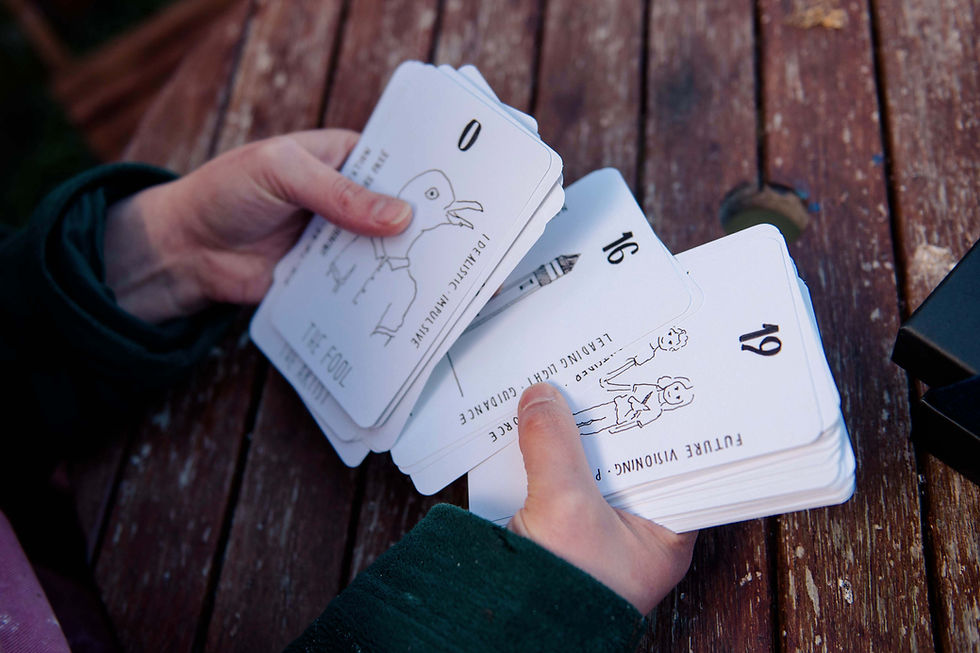
Over time, through lots of meetings, workshopping, and feedback, we developed the idea of a card deck. A game exploring the perspectives of artists, researchers, people with lived experience of dementia, and their carers on uncertainty, using the metaphor of the sea. We started looking into the shipping forecast as a way to log experiences of uncertainty. We were going to do it in an analogue way, but feedback from the advisors and carers was that it was too labour-intensive. They needed something more instant. So we developed, with them, a system: a WhatsApp community running for three months, where every Thursday at 12:01, when the shipping forecast came out, we sent them the music. We'd also made a list of all the shipping forecast words, and the idea was that they made a spontaneous reaction in words or images about where they were and their experience of uncertainty. We also sent each participant a monthly box of materials from the lab and the studio: jade glass, petri dishes, j-cloths and other things.
We had about forty people, a mixture of artists, researchers, people with lived experience of dementia, and carers. They all had their own private log books, and every single day we sent a provocation: an image, a poem, a piece from a science journal. All related in a collage-based, abstract way to the theme, to keep people feeling seen and connected, as the carers had asked. We then gathered the material from the log books and edited it. The card deck is made of two decks: one purely image-based and one text-based. All the material is generated by those forty people. Mar also put some of the information through statistical processes to lift out frequently used words. It’s playful rather than rigorous science.
I then took some of the imagery and threw it in the sea, and we played with it a little. We worked with Nico and Tommaso, who have a letterpress studio in Hackney Wick, to bring an external eye to the text and images. We invited the advisors to the letterpress studio to be involved in the process. There was a really magical moment: one of the participants had a spatial form of dementia, was putting the Ebb & Flow letters into the press, but because of the way she sees the world, she put them all in a different way around than usual. That's what we used for the front of the bag, because it was so beautiful. She was embodying the theme.
What Tatiana was really keen to get across — and this was important for me as an artist — is that this was a genuine collaboration from the start. It wasn't me as the artist illustrating their ideas or finding a way to make their vision happen. We had some discussions with UCL about this, around discrepancies in expectations of time commitment, but Tatiana and Mar both wanted to be equally involved. The budget would land with the artists and various other things, and we had interesting dialogues with UCL about what it means to employ people as equals. For me, it was about letting go of some control. Tatiana came to the studio, we built things, and we had a really involved dialogue. And we made the deck.
Was it always clear you'd make a card deck, or did that emerge through the process?
LC: A lot of people working on the programme made artworks for the building, but because of our theme, we didn't really want to make a permanent artwork stuck on a wall. It felt more interesting to make something that could sit on a researcher's desk when they were having a moment of uncertainty, or sit with someone who's caring for a person with dementia. One of the participants, a man whose wife has dementia, found that picking words from the weather gave her insight into how he felt, in a different way from how they'd been trying to communicate before. He couldn't communicate in a standard way, but he could say, 'I'm feeling Sunny,' or something like that, and she found it really powerful. We wanted to make something that could travel and continue to be active.
Can you say more about why the Shipping Forecast felt appropriate as a source of theme?
We had a big conversation about whether to use the shipping forecast or not. Tatiana is Colombian, and Mar is Spanish, so the shipping forecast wasn't as familiar to them. For the UK-based participants, there was a real comfort in it. Feedback from participants for whom the shipping forecast was not so familiar was that it still served as an audio/visual anchor for the project that they could engage with. The fact that something was coming every week, something repetitive and familiar, felt playful. In the past, I have worked with people with lived experience of dementia alongside musicians and witnessed the power and value of this.
Embodied routine is really significant for people with dementia. A lot of them hold on to embodied routine quite easily; they know where they sit at lunch, for example, even when specifics are lost. The shipping forecast is language, but it's embodied in a way that's so regular and rhythmic.
LC: The people we were collaborating with were mostly not in care homes; they were still living at home, and they were really active participants. We met a lot on Zoom. We were very mindful not to direct everything at the carers; we wanted to stay in dialogue with the participants themselves. I want to share some names: Diane did the letters at the letterpress studio. Charlie and Alison wrote poetry collectively as part of their log. Alison, who used to be an English teacher, was very much part of the dialogue, even when the whole concept occasionally got slightly lost for her. Ian was really into AI imagery, and he also made a very moving piece with some of the materials we sent him. He wrote about what his wife used to be able to do and what had been lost since she started experiencing her particular form of dementia, very spatially specific, including not being able to see the far side of her plate of food. He wrote: she used to write; I've lost that. She used to be able to come to the beach with me; I've lost that. It was really sad, but he was brilliant at expressing it. Having a space to be with the other four couples and share experience was a really valuable part of the project; to feel less alone, to share wisdom and ways of coping.
Caroline and Ian were another couple. Ian loved word searches, so a friend of Caroline's made a word search with all the weather words in it, which he brought to the exhibition event and told everyone about. Caroline turned the entire card deck into a quilt for a fair. We got all the images printed onto fabric for her, and she made a quilt where people could add their own reflections on the back. It was really beautiful.
It sounds like the card deck is one of many possible manifestations of a project that had lots of different outputs and lives.
LC: Yes, and it's still going. I've never liked static things; I like things to keep moving. A researcher fed back that she uses the cards with her partner when they're arguing. They pick a card and find a different way of thinking about things. I worked with a musician called Julian West for many years in dementia care homes; I gifted him a deck, and he's been using it to improvise music with care home residents. For other people, it's a souvenir that sits on a shelf; it doesn't get used as a game, but it reminds them of a process. I've used it in therapy myself. Two other therapists I know use it with their clients. I like that it can spread outside the context in which it was made. The experience of not knowing is a shared human experience, so it's not just for researchers and people with lived experience of dementia; it can be used by anyone.
Who was it originally designed for, and what context was it designed for?
LC: It was designed as a knowledge exchange between researchers, artists, people with lived experience of dementia, and their carers. It was designed to be something that lives at home or on a desk. We were also aware that with that range of users in mind, the game did not need rigid rules. There's a small die, and there's some simple invitations for ways to play. We included these as some people fed back that it felt too unsafe for them to have no parameters at all, while others wanted to make their own rules. So we made a compromise: very simple ways to play alone, with one other person, with three people, or with four people. It was designed to be played alone at your desk, or at home on a difficult day, or in dialogue. More specifically, the dialogue between a carer and someone with lived experience of dementia, and also in a wider group context. I find them hard to use myself either alone or in a group, because the images are too loaded for me. I know who made every single one, and I know what happened to them, and what was edited and why. Whereas if you're slightly removed from it, I think it is a more open game to play.
When talking to people about cards generally, it seems that some rules and clear parameters are actually what makes them useful. It's not giving someone a blank piece of paper and a pencil. It's saying: do something within this.
LC: That's why we made the flexible framework. But it depends on the context. I made another card deck recently for a dementia care home for people with very acute, end-of-life dementia; often, when I visited, many of them were asleep. What we figured out in this context was that there couldn't be any rules. We experimented and discovered that the shared experience everyone had was the act of scrunching. In the creative workshops, we co-created the imagery and themes. I then made the game in three versions: a large, tactile paper-and-fabric version on a table that you can scrunch; a card deck; and a perspex version. All of them are a combination of words, gentle invitations, and imagery that can be paired and moved around in any way. This openness removes the need/ pressure for there to be a correct way, which is not always supportive for residents.
Is it the basic act of connecting words, physical touch, and sight, just drawing those things together?
LC: I've been thinking about it, and I must have something in me that keeps returning to this form, because I've made three card decks collaboratively and they're all like this. One is called Double Lipped. I worked with a group of people for about six years, and we were coming to the end of the project when the funding ran out. We wanted to make a record of the process, so we edited all the workshop imagery and paired it with words that related to what we'd done. There's definitely a theme of word and image that keeps reappearing. I'm interested in the equality of word and picture, how they can be rearranged, how they can be read in a way where words aren't illustrating images or images illustrating words. They're in the same space.
Cards are always physical as well. I think there's some kind of connection to an idea of useful-art in that a deck is something someone can hold in their hand and do things with.
LC: I've always liked cards because they can be constantly rearranged. Before I started making card decks, I made a publication for a commission at Papworth Hospital with no binding so the pages could all be moved around. With cards, you have agency: you can take some out, ones that don't serve you, arrange them, rearrange them, shuffle them. They're tactile, and they never come out quite the same way twice.
When cards are placed together, they start to put parameters around the interpretation of each other's symbols; they gain more specific meanings because they’re side-by-side.
LC: Yes, and it's interesting, because I left a deck at work once and one client became very attached to a single image and walked off with it. I was fine with that. In these kinds of decks, it's not like playing cards. If one disappears, it's not a problem. There's something I love about the idea that someone has taken a single image, particularly pertinent to them and propped it somewhere. The physical qualities matter too: the thickness, are they the same shape as playing cards, or as tarot cards? That's quite loaded, and thinking about how you break out of those formats is interesting. These have rounded edges.
Do you track the impact or effect of the cards? How do you know the cards are doing what you think they’re doing?
LC: I don't. They're made for lots of different reasons. For the group of people I worked with intensively for two years, they're a record of a process, but there is the possibility for more than that, and we do know they're being used by other people, and we are getting feedback. It's just not systematic.
We went back to people at various points. We know from things like Caroline making her quilt from the images, and the quilt going to the quilt fair. We did an exhibition about six months after the card decks were launched, a big event where we shared the process with the people who'd made it and also a wider group, and distributed cards to them. Some of those people have fed back that they've used them. At the exhibition, a woman I teach in another context came, and she started talking to a man who had early-onset dementia but had taken part in the project as an artist. His wife was there, and they were talking about their experience with the cards. Then the woman started talking about her mother, who has serious dementia, and asked if she could take some cards back to her mother in Spain. I haven't seen her since, but I'd be interested to know how that went.
How many sets were made?
LC: At least a hundred. I have about eight left. They've all gone out into the world. What's quite nice is keeping a small pool so they continue to be in dialogue. Conversations like this one wouldn't happen if they hadn't been made. It is a limited-edition artwork in a way, distributed to people who are interested. We did talk about whether to make more and try to sell them, and people have expressed interest. But if someone showed real enthusiasm, like one woman who taught a lot of creative groups and felt they'd be really helpful, I'd just say: take them, see what happens, let us know.
The most important thing was the forty people who participated in making them. They were made for those people fundamentally. We mailed them all out. The advisors received extra packs to distribute to people they knew. We had budget constraints and could only produce as many as we could produce. But it sort of trickles out slowly, like a web. I've done projects before where people have sent me a picture saying they found my book in a charity shop, and I like that; it goes on to have its own life. They'll end up on a shelf somewhere in ten years, and some people will look at them and think: what on earth is this?
Are there other cards or games that influenced you?
LC: I've been doing something with cards for about five years now. I think it started when a friend gave me Oblique Strategies. She'd bought it for her husband, who already had a copy, and she said I was the only other person she thought might be interested. It sat in my kitchen for a long time, and when artists came to stay in London, it became a game we played, pulling a card and having a conversation. Then I bought a tarot deck by Sophy Hollington, a wood-block tarot. Really beautiful. I bought it at Donlon Books in Broadway Market. I'm not into tarot in its true form, but I do think it's interestingly linked to art therapy: you pull an archetype or a symbol, and that person's projection onto the card takes you somewhere. I started playing this game when stuck on something, pulling an Oblique Strategies card and a tarot card and pairing them in my own private game. I've been documenting it on Instagram stories since around 2020. Then I started looking into cards used in therapy. I got the Box of Emotions and divination cards from India, and Edward Gorey's really dark cards. Then Sharon Gal's cards; I think I found those at the Tarot exhibition at the Warburg. They've replaced Oblique Strategies for me now. I use them in so many different ways: at a psychotherapy college where I work, on taster days, I use the words to invite people to move around the room, and I use the colours to invite people to share their experience. They're great icebreakers.
I'm very particular about which ones I like. That tarot card shop near Leicester Square, I can never buy cards there; they're too mystical, too esoteric. I really like Liliane Lijn's cards. The School of Life cards can drift into a slightly corporate, motivational feel that I don't like.
Hearing that you paired two types of cards to produce a new set is great. I love that Ebb & Flow comes from playing and subverting cards that are designed to be playful and subversive.
LC: Yes, but the text in Ebb & Flow isn't a direction; it's not 'do this or do that.' It's often a single word or a pair. More poetic. Interestingly, word and image keep coming back. The thing I'm really obsessed with at the moment: I'm going to Marseille next month, and I want to see the Surrealist card deck there, a riff on the Tarot de Marseille that the Surrealists made. It's in the county museum. There's also a playing card museum in Paris I'd like to visit. And last year I had an extraordinary experience in Latvia, in a place called Kuldīga, doing an art therapy residency. I went into the local museum on a whim; it was quite small and about the history of the area. There was a collection of eight hundred cards. Someone had these thin wooden frames, a bit like you'd display textiles at the V&A, and they were pulling out deck after deck of the most extraordinary cards: playing cards, handmade cards, round ones, long and thin ones, hand-painted ones. Just loads of really beautiful imagery. I thought: there's a whole world out here.
I've got to stop making cards at some point, but for the artwork I'm making now on my own, I want to make a deeply personal deck using my own symbols, objects, archetypes, words that make sense maybe only to me. Just to see what that's like. You can make a small edition of two now; it's not complicated. I think that would be quite interesting.
I really feel I've met my match when it comes to people interested in cards. Do you think there's been a rise in card decks recently?
LC: Definitely, I wonder if it's partly because things are so difficult at the moment and something is seeking about cards, the play, but also the opening up of different kinds of conversations, ways of thinking, of finding a different way of being in the world. But I think they've also just become cheaper to produce. I used to research it and found you'd have to produce a huge edition, and the only real option was a playing card with a corporate logo on the back. Now, places like Aura Print let you play with the format.
Being an artist and having something out in the world is also quite expensive and difficult. Cards are quite an accessible format. They also allow several types of practice to converge: useful art, collective performance, visual culture.
LC: People love them. I often bring different decks out at the beginning of workshops as a warm-up, and there's always something about the response; it's so familiar, and yet the different decks are not familiar. It's immediately easy to understand what to do, and yet people are always delighted, as if they've been given a treat. The ritual of choosing is important. In tarot, you knock the bad energy out, or you use your opposite hand, or you throw them on the floor. That's quite interesting too.
When I'm facilitating a group with COTT, I get everyone to shuffle part of the pack when I’m explaining the rules. Everyone sitting and shuffling together seems to relax people a bit.
LC: For me, there's also a childhood connection. I used to play a lot of cards with my dad, and I remember really wanting to be able to shuffle properly. Cards are part of most people's homes. They're new, but they're not new. And they're so portable; I've always loved art that's portable. You put them in your pocket, and there's a whole world in there. They expand out to be so big. That's an amazing thing.


Comments