
Cards on the Table at Trellis Symposium

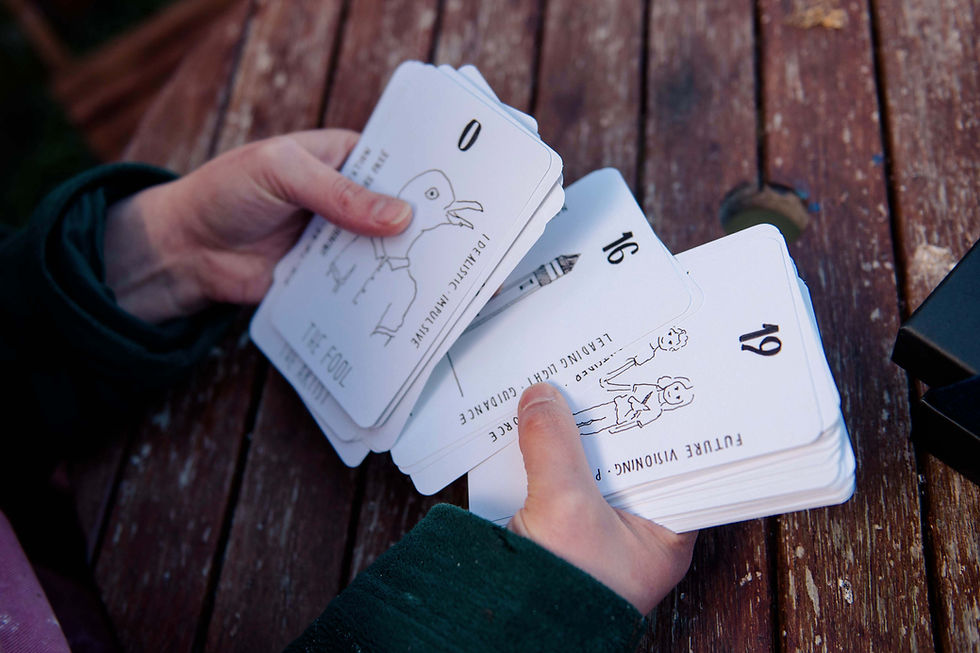
COTT at UCL Trellis Symposium. Image: Tariq West Carr
In May 2026, we were invited to facilitate some games of Cards on the Table (COTT) at the Trellis Symposium held at RichMix in East London. The event was organised to mark the culmination of eight years of collaborations facilitated by this wonderful UCL programme. Trellis brings together UCL researchers, artists and East London-based communities to share experiences, perspectives, and knowledge through co-created artworks. Recently for this blog, Henry spoke to Lucy Steggals about Ebb and Flo, just one example of the kind of project that Trellis has made possible.
Recently, during an Art and Economics reading group we organise together, we've had numerous conversations about the idea of being a professional. Such a label is difficult to apply to roles with no internally defined standards of behaviour, discourse, or identity. Often, those who consider themselves professional implicitly or explicitly exclude others based on those internally defined standards. “Being professional” can be a way to exclude those who might already be marginalised on other grounds, entrenching a hierarchy subtly defined but bluntly enforced. Trellis is a transdisciplinary programme that brings together artists, researchers and communities - lots of knowledge and expertise coming from lots of places. For this reason, we used the opportunity to facilitate games of COTT around the question:
What happens to the notion of professionalism in the context of co-creation, where different people come from different backgrounds and fields?
We ran four games over the course of the morning and asked participants to write down any particular phrases that stood out to them. We then wrote these on blank cards and added them to the Trellis COTT deck (forming a set of COTT bespoke to the Trellis project). Below you can read the quotes people added to the deck, and read our reflections on the games we played.
Games 1 and 2 quotes:
Everyone has got opinions
I’m not their mum
It’s all political
There is a professional inexpertism
You cannot de-complexify complexity
How are paradoxes within social/cultural dynamics able to help us understand the complexities within the dynamic?
It’s like cooking a perfect boiled egg
You can plan things thoroughly, but when you’re working with community groups, they’ll do what they want, and you have to respect that.
Having professionalism as the question for the COTT games seemed to elicit a specific behaviour among participants: my tables turned into networking sessions. It was interesting to think that, despite the ingrained informality of COTT, people still performed a behaviour which is traditionally attached to a professional environment. It is also true that, probably for many attendees, the Trellis conference was a networking space, which also translated into the game. That unexpected dynamic got me thinking about whether the context of a game/an event/a project is what actually defines the notion of professionalism. A possible line of thinking in regard to this point can be found in the “It’s all political” quote, which hints at the power structures hindering genuine collaboration. People might want to collaborate, but their existing notion of professionalism is not challenged enough by the new project context.
I believe that genuine collaboration requires us to forget about familiar contexts and to be open to completely new ones, hence to new definitions of our own professionalism. Yet, stepping into the unknown is usually what scares people the most. Thus, if people came to the conference and then the games as professionals and hence performed professional networking as a result, what new contexts might challenge this dynamic? In response to this question, I found the quote “There is a professional inexpertism” particularly relevant, as it suggests this exact idea of professionalism as context-dependent: different people are experts on different things and in different fields or areas of life or work. The way a project is set up, in other words its context, is what actually allows for these different expertise to find space and be equally valued.
Games 3 and 4 quotes:
Artists come in with passion projects for themselves rather than working authentically
I feel fear in not being able to let go of my expertise
Communities have provocative thoughts. We need to allow risky conversations
These people are the experts
Who decided what makes it in?
What could you do if you dwell more?
Talking to scientists (or people who work with scientists) was an unusual experience for me. I work in community and public art and rarely hear the perspectives of those working in STEM subjects. I was struck by one participant describing that when he talks to some scientists, it's as if they’ve never heard the term neoliberalism. We talked about a kind of a-politicisation of certain fields (or professions). To get things done, sometimes you need strong characters with focused perspectives (artists, academics, community leaders). These roles can come with habitual behaviours, methods, language and a clear sense of how to approach situations and what’s important within their field. As the first quote describes, artists can be guilty of putting their passions before the desires or needs of their collaborators. There’s a family resemblance between that behaviour and the one expressed by a scientist who doesn’t think their work overlaps with politics. Stepping outside of one's profession, letting go of expertise, can be scary.
Authentic collaboration (or transdisciplinarity) is when solutions are found collectively, with everyone’s input considered. This means allowing those who don’t fit the received ideas of professionalism to be heard and their ideas to be considered expert. We talked about allowing provocative and risky ideas to take centre stage, and that these ideas are as likely to come from lived situated experience as from traditional ideas of expertise. “What makes it in” can be as much about letting go of a professional standing as allowing oneself to feel the vulnerability of dropping a professional persona. But how can we do this? We talked about slowing down and dwelling - spending time just in a space, or just with people or things.
By Valentina Orru and Henry Mulhall


Comments