
Barrow Tarot with Katie Anderson
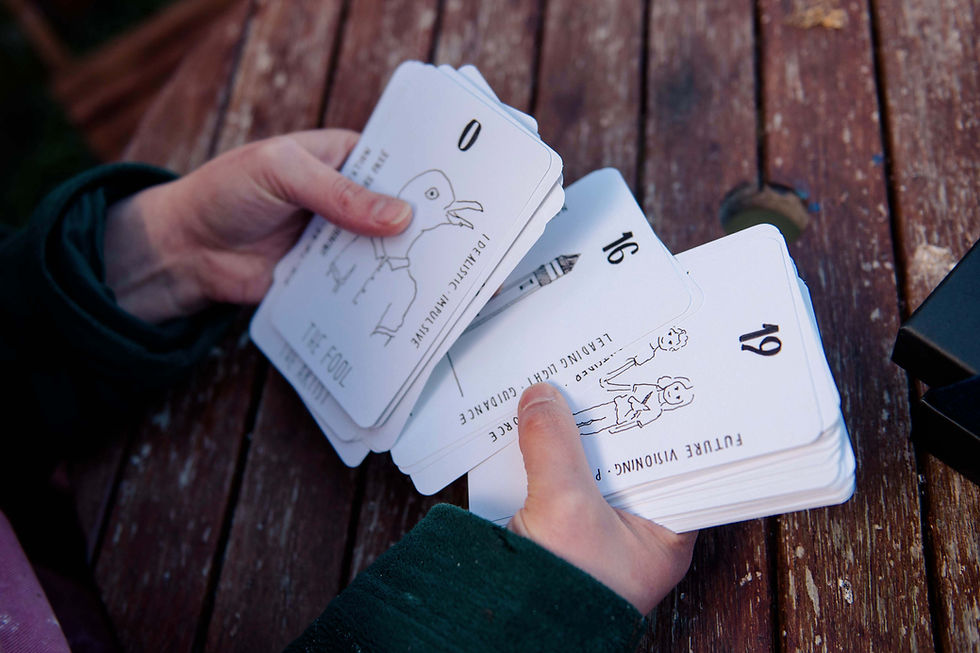
Image courtesy of Kirstin McEwan
Katie Anderson is a public artist with a practice focused on the role art and creative actions can play in activating spaces, energising those involved in its production and inspiring new ways of approaching challenging conversations or experimental ideas. Between November 2019 and March 2020, she worked with Art Gene in Barrow-in-Furness to develop Barrow Tarot. The cards are a conversational artwork based on the traditional tarot form. They are designed as a playful tool for exploring possible futures, taking inspiration from Barrovian identity and everyday finds. We spoke to her in 2025 about her practice and Barrow Tarot after seeing the cards exhibited at The Warburg Institute's Tarot - Origins & Afterlives.
Thanks for joining me, Kate. Can you start by telling me who you are, what you do, and give a brief intro into Barrow Tarot?
Katie Anderson (KA): I am a public artist, or at least that's the label I'm playing with at the moment. My background is in a predominantly visual arts practice, but I always work either creating work for public spaces, or working with an idea of publicness: working with community groups, working with groups of people to explore their places, their environments, things that are meaningful to them where they live. I do quite a lot of different kinds of work as part of that. Some of it could be pretty traditional, labelled public art, looking at things like permanent sculpture or waymarking for places, working with public realm activities, but I also like doing more ephemeral work, which is where a project like Barrow Tarot comes in.
Barrow Tarot began as an artist residency with Art Gene, who are really fantastic. They're based in Barrow-in-Furness. They've been working there for about 20 years, and they're an artist-led organisation with two founding artists, Stuart and Maddie, who started the organisation. They were really keen on a long-term arts practice that looked at how artists could lead a conversation about their place in Barrow, and what a long-term creative practice in Barrow might look like. Unfortunately, Stuart died last year, so it's now being led by Maddie.
They invite artists to come and join in that conversation they're having as artists, which is a nice, interesting brief. They tend to keep it really open when they invite people to play and work with them. I originally went to Barrow on a 3-month artist residency, on and off over the course of that period. The idea was to create a reasonably straightforward outcome for a series of events called Extreme Views, which was looking at how difficult, polarising conversations in the town were coming up. Everyone felt they had to jump on one side or another. People became really entrenched, and it was difficult to have a broader conversation about the challenges people were facing. It might be potholes or something banal, but actually, the wider problem is something more significant. Art Gene wanted to look at how they could, creatively, niggle at that.
The project was due to launch in spring 2020. One of the unexpected outcomes of the pandemic was that it dragged this project out for quite a long time, as we weren't able to complete it in the manner they'd imagined, and I kept the conversation going with them for much longer than the original 3 months. The Barrow Tarot project evolved in response to those really chaotic early stages of the pandemic, which feels like a weird fever dream at this point.
You say you are a public artist, and that encompasses what might be considered traditional public art, like statues and sculptures, etc. But you also say you work in the public realm through more durational or participatory practices. Are you actively trying to move away from delivering a physical object or piece of public artwork, towards things that are participatory and durational?
KA: I think it depends on the project. There are circumstances where making a permanent piece feels really useful and viable, but it's always done in conversation with whoever feels important at the time. That conversation is always going to start with commissioners or stakeholders, but actually, it's really about the people who are involved or interact with the project for a variety of reasons. A lot of the time, what I'm trying to do with my work is actually have conversations with people. I'm looking for different ways to have playful or different kinds of conversations. How do I start chatting to people about their ideas or their views, and how do we use conversational creative practice to work that out between us? Rather than just asking, in a consultatory way, what do you think about the park, or what are the challenges in the town, we're actually trying to use a creative set of techniques to help shift that conversation from “I think we need a bowling alley” or “I think we need the schools improved”, to having more of a dialogue about why some things might be difficult, why things might be interesting, why things are important to people.
In the past, some of my other projects have probably looked quite a lot like consultatory or engagement practices that you would often see at the beginning of a regeneration project. That’s about getting a community on board with an idea about regeneration, or exploring what that might look like in their town. For the Barrow Tarot project, I wanted to approach it a little bit differently, because there wasn't an expectation that we were going to produce something at the end of the project. We were really just beginning a conversation with people, or extending the conversation that already existed, bubbling underneath.
Public space is often considered the core premise or meaning of publicness, and therefore public art is often considered objects in public space, but I think that's actually the wrong way around. What you're talking about aligns with the idea that publicness is actually more about conversation or communication. The space and the objects come afterwards; they're only there because we're talking in a space. That's why it's a public space.
You're talking about mediating, and a lot of the time, it's not always public money. There might be some kind of public-private partnership going on that pays for this public consultation or public facilitation. How do you feel about that? Because this also relates to how Barrow Tarot was funded.
KA: Some of that does resonate. In terms of the funding, with most of my other projects, the money is often public. I haven't really worked directly with private developers. Most of the projects I've been involved with have been community-led, rather than someone looking to consult gently with the community before pushing on with their larger goals. In terms of the Barrow Tarot project, I'm pretty sure it was Arts Council funded. Art Gene, as an organisation, receives funding from several different funders, currently including Arts Council England and the Cumbria Business Growth Hub & Rural Growth Network.
What is Barrow Tarot? How does it work?
KA: It's an interesting tool for directing conversation. I came at this with zero experience in correct tarot, which I've always felt a little guilty about, given how little my proper tarot knowledge is. I took the structure of tarot, in terms of how the card deck is laid out, very loosely, and borrowed and adapted it for the kinds of conversations I was having.
What I tended to find when I began my residency, because I'd never been in Barrow before and had no connections or understanding of the place, was that every time I had a conversation with anybody, whether staying in Airbnbs or shared housing to chat with different kinds of people who lived in the town, going out for coffee, those passing chats you have, or in the community garden that Art Gene helps run, every time someone would mention something, I was gathering all these bits of Barrow as I was trying to make an internal map of how it works. Some things came up often, over and over again, or some things were just strange and curious, like those lovely little bits of how people know their places, which you pick up as an artist starting somewhere new.
The Barrow Tarot deck is split into four houses. It has a minor deck and a major deck. The minor deck is split into four houses, which I've readapted from traditional tarot into the houses of Industry, Environment, Culture, and Community. They follow the same structure: an ace, a king, a jack, a page, and a queen, and then numbers from ace up to 10. The major deck runs from 1 to 21. I kept a couple of the original tarot cards that felt really useful: there is a Fool card, a World card, and a couple of others that will look a little bit familiar if you have an existing knowledge of traditional tarot. But the rest has gone quite off on its own tangent, and the more I started to work on the structure of these houses, and where people got placed, and an imagined framework, it grew into its own thing, which I just rolled with after a while.
Because of the name, whenever I bring the Barrow Tarot out, I know I get a variety of reactions. The deck was designed to have very specific conversations about the future of Barrow. If we were going to imagine a future Barrow, how could we take our understanding of the town as it is now and has been in the past to inform or be inspired by for the future? Barrow gets a bit of a bad reputation. It's not got a great name outside of Barrow itself, but it's a really spectacularly interesting place. There's a really good sense of community, an amazing environment, and the heritage and history of the place are staggering and full of fascinating nuances. As a post-industrial place, it's gone on a huge journey, so where Barrow is at the moment, and where it's going in the future, is really interlinked to all of these things. I wanted to use some of that to help jump people out of the conversations they were getting stuck in.
I can’t say I know much about Barrow. What was Barrow's industry?
KA: It is on the coast, at the bottom end of the Furness area. Originally, there was a big monastery there, and a small village. They started bringing coal and iron in on a train and shipping it out from there. Then they started the Vickers Shipyard, which was renowned for building a huge variety of ships, and that moved into being BAE Systems, the submarine builder. That's what the town still is. It was entirely built around industry. In about 150 years, the population went from about 700 to 60,000. It had this enormous scaling up, so it's full of very beautiful buildings that were built at a time when there was lots of prosperity and money in the town. One of the major issues now is that there's still a major industry in the centre of town. The BAE operations are enormous and literally in the centre of town, but the money from that industry doesn't support the rest of the town in the same way. That gives Barrow a real problem with its identity. When it was Vickers, everyone in the town was part of that skilled industry. Now, most of that skilled industry is for the existing systems, and I should add, the largest offshore wind farm in the UK is just off the coast of Barrow, which is external to the town, and the money is going straight back out of the town again. It leaves a difficulty between people who are long-standing in Barrow and newer people who are coming in and out just for work purposes.
You've given a really good introduction to the potential issues that a town might have, some quite common in the UK, some quite unusual. Who uses the cards? What kinds of situations did you find yourself in where you were trying to apply Barrow Tarot to mediate?
KA: To start with, they were just one-off conversations. I was going to the market, chatting to people, pulling cards out, and allowing us to have really quite open-ended discussions about the town. Then I was asked to work more directly with groups, or people would request to use the deck. For example, I worked with some secondary school groups on a separate project that looked at their relationship and understanding of their local environment, and how they could impact decision-making where they lived. We used the tarot deck initially as a way of exploring that conversation and opening things up for them. What became interesting is that people from outside of Barrow wanted to play with the deck. I spoke to a group of artists in Florida who wanted to reimagine the deck for themselves. We spoke about how the deck worked specifically and how they would reimagine that process. For other places, people have wanted to take the Barrow Tarot deck as is to bring it to their own communities. Gardening groups in Edinburgh have played with them, and community groups in Dumfries have used them as a tool for having more open conversations. It allows people to take their conversations in directions they weren't expecting.
Is there one deck? Or editions?
KA: I made a deck, but we made them into an edition of 100, which I think is still available for sale from Art Gene themselves. I haven't checked in a little while. I initially imagined this as a tool that I would use. I can bring a lot of the details of the individual cards with me. Whereas, once people have purchased the card deck for themselves, they're taking the lead. I've had some feedback that it still feels like a really useful tool, but I've never been able to listen in on how somebody else would use the deck without me leading the conversation.
That’s one of the questions, actually; how do you know the cards are doing what you intend them to do? Are there rules? Do you encourage people to follow the rules on the website, or are you happy for people to use it however they like?
KA: I'm pretty happy for people to go off-piste. One of the things I got interested in with traditional tarot is how differently it can be used and how people might draw cards or use a reading for completely different purposes. A lot of it then really came down to how much time we had and how in-depth we wanted to go. If we were doing something quite quick-fire, we might ask people to go through the deck, find a card they find interesting, pull something at random and have a conversation about it. You can use the cards in a stepping-stone manner, or you can go deeper.
On the website version, where you get given three cards at random, I tend to find that when doing that in person, we might then want to find another card that helps, or we do three and then find a major card that gives us an overview. If I pull a few cards and we have a chat about what they mean and where the original interest in those things lies, what they might bring to the person in the conversation they want to explore, we might end up feeling we need something else to take the conversation a bit further. Otherwise, we can get a bit stuck; we've explored something, we've learned something, but we haven't really taken our ideas further yet. That varies from individual to individual, and also depends on what people come looking for. When I did the tarot readings in London at The Warburg, curiously, almost nobody had heard of Barrow before, so nobody was aware of the context of the cards, despite it being mentioned in the event listing. Most people came looking for marriage advice. We did do marriage advice from the perspective of wind turbines and post-industrial systems. It was playful, and I was very careful to caveat everyone's expectations at the beginning, but I thought that was actually an interesting way of introducing this conversation to people who weren't expecting it.
I think something quite interesting about these cards, and other cards and practices I've looked at, is that a combination of choice and randomness is quite helpful to stimulate people to talk in new, different ways, or just more openly. People have some sense of agency in the process, but that's also being complemented or challenged by a random selection. Was that designed into it, or is it more essentially a random selection and then people trying to find a connection?
KA: Some people really do go for complete randomness, but I really learned how to use it through doing. The first couple of times we took it out, we were just going, let's try this and see if that works, and if not, we'll try something different. It's taken quite a bit of play and learning to be confident about the concept of the deck and its limitations. The deck isn't designed to provide answers; it's more a way of redirecting conversation and making sure people feel like that's something we're beginning with. I think that really helps people in terms of their expectations about what we're getting out of the conversation, because most people arrive with a set of expectations about what they'd like to get out of it.
Not being led by it completely is a facilitation skill as much as something built into the cards.
KA: Yes, I think so. Someone pointed out to me a couple of readings back that this is a tool for facilitating conversations as much as anything. A lot of artists end up learning some of these skills when working in a community setting, and not always using them in a very conscious way. It's something you're learning through trial and error.
On the subject of mediation, using this to mediate difficult conversations, or conversations that are blocked in some way. You're presenting people with three cards, and they'll probably know the images on them because they're from Barrow. Is there something there for you about making a thought process and conversation public for people, trying to bring issues or positions out into the open? Is that part of your motivation?
KA: Yes, I think that really helps. When you start having those conversations where there's a strong sense of opinion, or something's already bubbling, there's the question of — as an artist coming in, especially if you're not a local person — why are you bringing this conversation? There's that underlying narrative that people have learned to be quite cautious about, particularly in communities that have had a lot of consultation or engagement that hasn't resulted in anything really changing for them. As an artist engaging in that conversation, I don't want to do that in an extractive or exploitative manner. I want this to feel like a useful tool for people to be thinking a bit bigger about those conversations they're getting stuck on, rather than me concluding that the things we should be doing are X, Y, and Z. I've tried to make this project less about me spearheading that next-level change, and more about allowing other people to feel like they've engaged in it for themselves.
You're also making your own position public through the use of the game, saying, " This is what I'm here to do, this is me in this place”. Was that a conscious decision?
KA: That was quite a conscious decision for me in this project. Almost all of my practice since I left art school has been really public, but didn't come from a background in this kind of publicness or training in mediation or conversational practice. I've learned quite a lot of things through error. When starting out a project in a new place, I thought there was a potential to do this in a slightly more self-aware way than I might have done previously.
Okay, so why cards? Why a tarot deck?
KA: There's a funny thing, I actually cannot remember how I started making these. I was really allowing myself to get into that arts residency brain. When you're in a different place, and you allow yourself to be taken on a journey by what you're doing, it can feel a bit like going on holiday, getting out of my regular routine; you might find yourself doing things in a totally different way. A lot of what I was doing at the beginning of that residency was following the strange conversations I was having with people, and then going off and looking for whatever they told me about. What became apparent about the card deck, and why it really evolved into what it is, is that a really small, compact thing, but also a familiar structure. Even if people have not engaged with traditional tarot properly before, they know what it is. They have a preconception about what it might be for, and it allows you to have this one-to-one conversation that can sometimes be a bit tricky otherwise, just sitting down and saying, " Right, tell me your thing”. That, as a cold conversation, is quite hard to do, whereas through the premise of these cards, we could come at it quite gently for people who might otherwise not normally want to play at that sort of game. As part of the project, I ended up building a little desk with a glass top, so we could look at the cards in a little compartment space. That was partly designed for COVID, so we could use it as a screen for the point where people were feeling anxious about personal face-to-face conversations. I built up a bit of ephemera and a set of visual signage that tends to follow my practice around, a collection of things I could unpack and be in a place with. For all that, I wasn't arriving with a big physical activity; I had a pack of cards, but I was able to go and occupy the space in a quiet, gentle way, and people understood what they were coming to take part in.
With public art projects, people can sometimes watch from across the street at a safe distance, and they have to make a decision about whether or not to step closer and engage. Whereas with this, people were able to get it really quickly. It's a card deck; you sit down and have a brief conversation, and there's also a good get-out, because it's only for a short period of time. If you don't like it, it's easy to leave. That's a nice, safe option for people, giving them a bit of confidence in chatting to a random stranger about something. There are lots of nice parameters in using a card deck that are just really useful and allow people in.
You did all the illustrations on the cards, is that right? Is the deck a piece of public art? Rather than a tool you're using to facilitate conversations, or is there no difference?
KA: I see the deck as the artwork, but the artwork is still a tool for facilitating the conversations. Without the conversations, if it were just a deck in a gallery, it's not really that interesting as a piece. As something we can use as a participatory piece of dialogue, it becomes interesting as an artwork for me.
I think that's interesting, even if you're considering it as a large drawing. It doesn't really got a fixed way it should be seen, which makes me think that even as a drawing, it's still disrupting that kind of viewer-artist relationship. Did you think about it in terms of the drawing? Were you thinking you were designing a deck of cards, rather than doing a set of drawings?
KA: That’s one of the things I got a little hung up on, because normally I wouldn't put my drawings anywhere near a public space in that way. Drawing is a way of solving problems and figuring things out, for me. Originally, I scribbled them all out on bits of paper just as a way of remembering things, and I'd been thinking about replacing the images with something more solid or specific. Actually, the Art Gene artists thought I should definitely keep them. The weird drawings are great; there's something in them being a bit rough that works. They've got a lo-fi style that is helpful. It gives enough of a hint about what we're talking about without getting too bogged down in visual imagery.
They're quite basic drawings, but that’s quite difficult to do. It's not an easy skill to have something clearly be what it is, but not any more than that. That's a big difference from traditional tarot, where the cards are often incredibly ornate, with a whole world within each card. Yours are quite clear and straightforward.
KA: The exhibition at The Warburg in January was such a contrast. There were all these insanely beautiful, detailed decks, and mine had a very different kind of visual language, but was playing with some of the same curiosities. It was fascinating to see it considered in that different conversation.
Other than tarot, which is an obvious influence, was there another game or practice that influenced you when you were thinking about making them?
KA: That's the question I was thinking about most, because it's been a while. One of the card decks I mentioned to you in an email is one called Presence, which some friends of mine created. That’s a much more direct way of looking at difficulty within creative practice, a set of cards that might help people unpick that. I think we'd used it within some of my other creative projects, and I thought it was quite an interesting, useful format. Their cards are a similar size, with interesting textural pages, and each card has a series of questions and a title: The Spectator, The Offered Hand, The Engineer, characters in a similar vibe to tarot. I thought that was an interesting way of making us reflect on our own practice.
I was really influenced by Art Gene, who made a series of traditional walking route maps of Barrow that were full of really obscure details, showing small bits of knowledge about a place. I loved how much detail was hidden in these. When we first started there, Stuart gave us a copy of these maps and took us on a tour around the town. As an initial way of learning about the town, it was through the visual language they'd started to build as an arts collective. Being able to come into an artist's project having arrived with somebody who had such a strong knowledge of their place really helped inform the work I was then able to make in response. There was so much groundwork laid, and they were so well embedded in the community, that it allowed the Barrow Tarot work to be made in that way.
Something is interesting about the idea that details are hidden. They're not necessarily complicated details, but the more you zoom in, the more there is to see. That's quite a nice parallel with flicking through a deck of cards and then looking around and seeing more details in little places.
Is there anything else you'd like to mention about Barrow Tarot?
KA: I like that it's had a much longer life than it might have had and how it keeps being picked up. I'm not totally sure how it keeps resurfacing in different places, but the card deck is slowly starting to go off and have conversations outside of Barrow in different places, and that's an interesting opportunity for this kind of work. It can join other conversations.
It's a public artwork for Barrow, but it's a public artwork that can travel around, presenting Barrow, or something of Barrow, wherever the cards go.
KA: Yes. I've done one exhibition where I brought a couple of those bits of Barrow that could then tour, and we started to have conversations about that place somewhere else. It allows Barrow to see itself in a different place, but it also allows other people into the conversation in a wider way than a first glance at Barrow as a place might give. Barrow might not immediately reveal the wealth that the place really has.


Comments