
Etudes with Sharon Gal

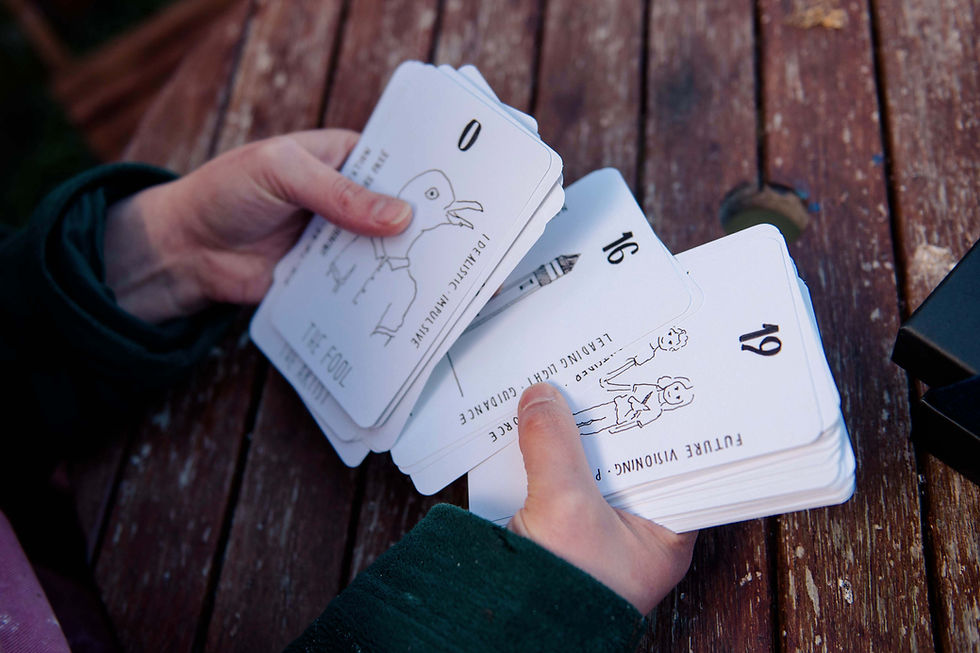
Image: Sharon Gal giving an Etudes reading, courtesy of Sharon Gal
Sharon Gal is a UK-based cross-disciplinary artist, composer, and experimental vocalist. She creates collages and live, often improvised, works. For the last 30 years, she has worked as a solo artist as well as producing large group compositions with anyone who's up for it (not only professional artists and musicians). In 2020-2021, Gal made Etudes, a collection of 78 cards that can be used as scores and propositions. A music, performance and art resource, the cards act as a catalyst to inspire and trigger the imagination. We spoke to her in 2025 about her practice and the Etudes deck after seeing the cards exhibited at The Warburg Institute's Tarot - Origins & Afterlives.
Thanks for joining me, Sharon. Can you start by telling me a bit more about your group compositions?
Sharon Gal (SG): There's always a title, which is where the piece starts resonating. It's an open call, so people see the title of the piece, start resonating with the idea in their mind, in their imagination, envision themselves being in it or participating in it — that's where it starts. Then we come together in person. I guide them with text instructions or just very simple ideas to try things out. We go through a process of experimentation, then have a little break, and usually perform as a group at the end of the day in front of a live audience. It's quite a quick process; it brings people together, and each piece focuses on slightly different aspects. The idea is that anyone could join; anyone who can play one note on any instrument could join; anyone with a voice could join. There's a piece for voices in a staircase, a drone piece for a large ensemble and many instruments, a piece for m/any voices in a public space, a piece for guitars and micro amps - It's a feedback piece, in a way, but working with low volume, and what we create involves a lot of people moving around the space.
Is it largely about bringing people together: musicians and non-musicians? Can that line be drawn, or is anyone who takes part a musician?
SG: I'm not really interested in the distinction, or in the title of what a musician is. For me, it's working with senses, with listening, with the ability to sound, with the idea of interaction, coming together. Whether you say everyone is an artist, everyone is a musician, that could be it, but I don't even look at that. I'm just saying, let's create. I think creativity is inherent to us. If you have the urge to participate, join, be playful. Playing music is about being playful, and that's forgotten many times nowadays when we talk about musicians. The seriousness of it puts aside the original notion of just being playful and joining together. Anyone with a voice can make a sound and join others. I want to introduce people to the idea that you don't have to be a professional in order to create music, or to create in general, or to have fantastic ideas, communicate, and collaborate.
I introduce a loose frame that gives people, who don't have such experience — in particular in regards to performance — a sense of security within the group, to then take chances for themselves. The content is always coming from whoever the participants are. A simple suggestion will be interpreted quite differently, depending on their experience, their mood, their ability. That's what I'm interested in: these variations within a group. The same idea can be interpreted and sound differently, and then you can play with that. That's what makes things so interesting to me within a group context. It's about coming together to create something, working with our unique experience, our senses, our bodies, and our ability to interpret suggestions and respond to them.
You're offering a structure that people can move within, interpret and take part in. I can see how a set of cards fits into that approach. Could you tell me about the title, Etudes?
SG: Yes, it relates to the musical etudes. Originally, I was thinking of it as a self-practice, self-exploration, something someone could do on their own, to try things out, experiment, take chances in their intimate, personal way. It grew out of that. I wasn't really intending to create a deck. I was thinking about those large group compositions and how to introduce them, because I've always been part of the group as a performer and as a leader.
There isn't really a predetermined structure. The structure evolves and is created through the engagement. It's more like a net or a loose frame that people can work within. A different structure is created for each piece, depending on the people involved.
Another crucial aspect for me is the space we work in. Each space becomes a collaborator, shaping the piece because of the way sound carries, the way we respond to it, the way we move around the space. The work is site-specific. I was thinking about how to communicate these ideas if I'm not there in person to guide people. I had several pieces and compositions that I wanted to write down, and I was thinking about how to compile them. I didn't like the idea of creating a book because that gets set in a particular order. I really like the notion of flexibility, the ability to approach things in different ways. These are text pieces, graphic scores and open scores, which is what I like to call them. Individual, unbound pieces on different cards. So I thought, why not a card deck? And I love the tarot and use it a lot, not necessarily in a musical context.
I was also thinking about the notion of movement. I didn't want to explicitly say things to people; rather, I like them to discover through playing. Shuffling the cards and moving around does something without people actually thinking about it. Moving your hands, eye-hand coordination creates an internal process that you don't necessarily have to be aware of intellectually, but it does get the flow going and influences the way your thoughts form. A card deck became a possibility, and it ended up becoming a score in itself, a way to reach people across time and space.
By chance, it coincided with COVID just starting. The whole development of the deck was through the first year of COVID. How do you come together when you can't actually meet people in person? All these pieces, until then, relied very much on the energy and presence of people, the actual meeting, seeing someone, experiencing them, not through a flat screen. Even just standing silently and listening, people can respond to each other and sense each other in a way that's different from watching an image on a screen.
I was thinking, how do I get in touch with people? How do we communicate across time and space? It then became this possibility of an open score that would allow people different ways to interact and different starting points. And it enables people to make it their own.
It became a catalyst for creativity, something to start with, an idea. Not necessarily a finalised piece. It can be combined in different ways, which I really like. Each time you approach it, it's different.
It was important for me to include text, but I also wanted it to be sensuous, to include the senses. So there is text on one side and colour on the other. Each card has a specific shade, and there are families of colours. Each shade is unique, and no card is the same as another. When you put those against different backgrounds or surfaces, you get different impressions. It's vibrational. I really wanted to introduce the option of ignoring the text, ignoring the intellectual approach of thinking about words and language and just seeing something against something else, or two cards against one another. Or just shuffling, making this movement of different colours and getting ideas that way.
When you open a pack of the cards, what's in there? Practically speaking, what does someone see? And you're saying they use them in a quite free way, but is there any guidance on how someone picking up the cards might use them?
SG: As it was developing, I thought, because I love the tarot, I'd like to maintain this loose frame and connection in the way the deck is shaped. It has the same number of cards, and it relates to the Major Arcana and the four families. The deck has five colour families or groups. The first relates to the Major Arcana in shades of purple/violet, which is considered a spiritual colour. I thought that would work well with the archetypes. Then there are the blues, greens, yellows, and reds. They're loosely based on the Tarot’s families and the different suits of the playing cards, relating to the traditional colour association of those suits.
The text is not directly related. I chose a very large number of different phrases relating to movement and sound; familiar phrases that people would know, mostly. Some were my own ideas, but mostly familiar phrases, which I tried with different people to see what resonated, and narrowed down to the 78 cards based on what people responded to best.
With the Major Arcana — the first suit, the purple suit — relating to the archetype, I tried to make some connection to the text and the essence of each card. With the others, it was a chance operation to decide which text goes with which family. The graphics are different across families. The yellows have two lines and two optional directions to read each card, so you can choose. The reds are the only ones that have colour in the text. The blues are more graphic in the way the text is set and presented. So there is a distinction for each family with a different way of expressing the text.
Without telling people about the Tarot’s origin of the deck, I wondered if something of the essence or the power of the Tarot would stay embedded. It wasn't an intention, just a question. The idea was to introduce it as a creative resource that you could shuffle when you want, or just play with. You could relate to the text or not. Be specific and focused, or not. It was left quite open. A lot of the possibilities materialised afterwards, when people started playing, and I started playing, and then realised these added possibilities and options rising from just the usage and engagement.
As it manifested in the world becoming an object, I wanted the cards in a hard box that also vibrates colour. The design was by my sister, who's a graphic designer, and I love it. I was thinking about resonance, and vibration, and colour, and sound; things that are in the world, that we respond to intuitively, to be utilised without making too much of a thing about it.
I like that we all see colour differently, so even though it's the same object, everyone's interpretation is slightly different. It makes it personal and unique.
I never thought about the text becoming something you could actually ask questions about, like with the Tarot. Some people just started playing that way. I did some readings with people, and it was surprising what came out of it. It wasn't intentional, but something worked with the readings and the way people interpreted it, which made it personal and special.
I was originally thinking of it in the context of music, sound, and voice, and then people started using it for writing books, making plays, interacting with others in different ways, for paintings and visual art, and all kinds of creative projects, far beyond my original thought of creating a collaborative piece with others.
Each card — in terms of its colour, the way the text is arranged, the text itself — is like a visual score. When you start combining them, they become a slightly more complicated visual score. Visual scores are a set of symbols that suggest certain kinds of actions. Linking it to tarot, I hadn't thought about tarot in that sense. The actions stemming from tarot might be quite different from those stemming from Etudes. Tarot suggests an internal reflection about one's position in the world, whereas you're encouraging an outward collaborative action.
SG: Not necessarily. It can be a process of thinking about something. There were specific cards, particularly with the archetypes, where it was important for me to get it right. I couldn't just put any text. So there were cards where it was important to make a connection, even though it was only my own connection. For example, the first card in the Tarot deck is the Fool, which doubles as the first card and as card number twenty-three. The Fool starts the journey through the Major Arcana cycle as a naive, unknowing entity, and ends as The Wise Traveller after going through and experiencing the different archetypes. I thought the colour white would suit it, because white includes all the colours and all possibilities. The text reads 'A Leap Of Faith.' A leap of faith could be something you act on in the world, or it could be a shift of thought, an internal process. It doesn't necessarily have to be a physical actualisation of a piece, and you could work with just one card.
I suggest and encourage players to find their own way of working with the deck. I included a few suggestions as to how people could start approaching it, just in case some didn't have a clue. I thought it would be good to invite people to shuffle, to get this action and movement in there. But then I also said do whatever you want, whatever feels right: you can shuffle in different ways, play around with it, see what works for you, cut the cards, see what jumps out. The idea is for people to discover and find their own approach. As they work with the deck, the deck becomes their own invention and what best works for each person. It's a very personalised journey for the players, so each could find how best to utilise this resource.
I'm quite mind-blown by the way people have been using them, in a much wider scope than my original thoughts. I wanted to introduce it, and then let it find its own life, presence and purpose in the world, so it becomes the thing that each person needs. Once it comes out of me and is in the world, it's up to the person. If they have this initial resonance, they work with it and make it their own. The deck means different things to different people in the way they use it.
The death card — part of the archetypes — I thought of as black in colour, with the text ending and beginning written in two lines to be read in opposite directions. Again, it's something you could think about. You don't necessarily have to actualise it, but you could, or you could put it against something else, or use it as a minimal concept to be applied to whatever you're doing; a thought, a state. It depends on the person.
A painter I know doesn't usually relate to the text. She just does different shufflings, sees what comes, and adapts to her palette. For her, it's mostly the visual: the colour, how it works with the surface and against it, and other colours, and the depth gives her an idea that she takes into her own work.
I like 'Leap of Faith' as the Fool, because a leap is quite physical and outward, and faith is more personal and internal, but also universal. I’d like to know a few more practical details: how many packs exist?
SG: There are two hundred decks. It’s a limited edition. Out of that, around twenty are reserved for hands-on group practice. There are still about fifty decks available. Then there's the question: do I want to do a second edition, and if so, how do I respond to it?
Regarding the white card — the Fool — I remember I introduced it to a different musician to try out initially, and some people just passed over it. Because it's a white card, and when you get the deck, the colour side is up. You have to turn it. The deck opens, and this is the first card. They just took it. They didn't even look at the back; they assumed white was, I don't know, not a colour or something. It was quite interesting to see how people relate to things and consider the possibilities. For them, the white was just like in-between, or just the one before we start.
Like you're saying, it's everything and nothing at the same time. There are infinite possibilities, or no possibilities with white?
SG: Exactly. When you buy a book, the first page might just be white, and you turn to the text. There are preconceived ideas about how we approach things. The colour side is what you see first, so you have to turn it. It's a movement you need to do in order to see what’s on the back.
I noticed a lot of the texts seem to be in two directions, so the dealer is reading something as well as the person being dealt to.
SG: Some of them are, but a lot of the arcana cards are just one word. There is a particular group — the archetypes — that has pared-down ideas. There is one family that has two possible directions for reading the text, and then again, it's a choice. For example, 'by choice' or 'by chance’, two options that relate to each other, so you can think about them, or just choose one.
Was your original thinking that someone draws an archetype, and then another card? Say, a 'change' card and then a 'by choice, by chance' card, and it's the combination of those two cards together that starts to suggest new ways of working?
SG: Possibly, or it can just be one card. It's up to the people. If I take this blue and put it against here, or against there, each suggests something different, different combinations of colour that might resonate differently. Some people like a lot of cards. I personally prefer to keep it to around three. Three is a good balance, a nice energy between the cards. Looking at them individually, and then starting to draw and connect.
Tarot has quite prescriptive rules.
SG: It's really a resource of colour and text. Play with it, throw it up, see what comes. Even with that, it was interesting because the phrases are in English and quite specific. For English speakers, some are very familiar. But a friend who's Chinese and whose English is not that good has totally wild interpretations. She plays with the sound of the words because she can't pronounce them the same way, and she's not bogged down with preconceived ideas about phrases. She makes these wild possibilities out of things that other people might think are really familiar. That drew me to the notion of choosing a language that's quite restrictive in many ways. Others who don't speak it will see it differently, but it might also make it difficult for some. It can be a way to open something if you don't understand it properly, but it could also cause people to get too heady about it, which was not my intention. The language is interesting, but it suggests a certain restriction of thought, in particular relating to some of the phrases.
For the reader: you held a blue card against the wall, against your jacket, and that visual, physical possibility suggests things.
SG: Yes. Some people actually relate to the colour in a very strong way; they might put it on their heart and say they feel the resonance, or it suggests a different breathing. People relate differently. Some are extremely sensitive to colour and colour frequencies, which is another opportunity for people to interact in a non-verbal and mystical way.
I was later invited to take part in an exhibition about Tarot, about decks that had moved away from the Tarot but are still related to it. They invited me to do some readings, like you would approach a more traditional Tarot reading, even though it ended up not quite like that. In general, people who buy the Etudes don't usually buy it as Tarot cards. They buy it as a creative resource and find their own way to explore and play with it.
How was it originally paid for?
SG: I was part of a program called New Voices by the organisation Sound and Music. One of the advantages of taking part was to create something at the end of the program. Usually, people create a piece. It's mostly for musicians, composers, and performers, relating to sound and music. I had the idea of creating a video performance piece, but then COVID arrived, and everything changed. I was already considering the presentation of my collaborative group pieces and the possible form this could take, so I thought, why don't I actually go and develop the cards? They loved my proposal, and I'm really happy with the way it all turned out. It made it possible to develop and publish the work with their assistance, support, and financial support. They commissioned it, in a way.
I created this object that now exists in the world, whereas a lot of performances are much more ephemeral. Even when you document or make a video, it's never quite the same as actually experiencing it in person. So it turned out fantastic, even better than I hoped. Sound and Music supported the publication of this first edition, and now it exists, also as a kind of a sculpture that takes shape and space in the world.
What you were saying at the start, the idea that it's almost like a book- you were thinking about producing a score in a more traditional book format, with a set linear structure. A lot of card decks have that book quality, like a book you can read in your own order, a collection of thoughts and text in one place.
SG: Yes. Coming from improvisation, free improvisation in particular, which I love dearly. The idea that every time you approach it, it's different. You are different. The possibilities are immense: different combinations, new opportunities, new ideas, new suggestions, new resonances coming into fruition through this interaction. It's like stepping into a river. Is it the same river each time you step in? You're not the same, and the water is flowing. Maintaining this notion of flow, and life, and time, we are part of the river of life that is not fixed. It's flexible, it's lively, it responds to how we are, even if we're not aware of it sometimes. I like the freedom and the playfulness to just be, and accept that being is something in flux, changing, playful, and not fixed.
Do you know that Borges' story about someone who rewrites Don Quixote is called Pierre Menard, Author of the Quixote. The titular character rewrites the exact same Cervantes text, but it's always different because it was written by someone else at a different time in a different place. The thing is the same, but never the same.
SG: That's the loose frame, you know the parameters: there are 78 cards, there are these colours, these families. But the actual interaction is fresh and new each time. That's really important to me generally in my work. The format of a card deck really enhances that. Just by doing it, you can't help but be different each time. The fundamentals that exist under the surface are very powerful, but they're not necessarily something you're aware of intentionally; They still affect your outcome and behaviour.
You mentioned collage as part of your visual practice. There's something here about a collage approach to working and understanding, a collection of things from different places that sit together. The cards are almost like a temporary collage that can be interpreted by people.
SG: It uses a similar approach, though you could also say jigsaw or other things. For me, doing mainly Collage now is practical. When I was doing painting and 3D work, the pieces became like my kids. I needed to take care of them, make sure they're safe, and if you're not selling them, they take up space. Collage became a very practical way to keep doing my work with that playful approach that I like and less worry. I also use it with sound when I make recordings; I use various sound sources that I then put together and bring together in new ways. I like taking different elements from different places and bringing them together. This same approach invites people to do that with the deck and within the Etudes. But whatever people bring in, that's their material and their own contribution.
Could you give me some examples of groups you've worked with? Who are the cards for? Who's using them?
SG: It's still my aim and intention, as in the beginning - a creative resource and a catalyst, to inspire and trigger the imagination. It doesn't necessarily have to be finalised or have an outcome. It can be a process. You don't even have to produce anything; you can just sit and shuffle, look at the colours. A meditative practice, a way of relaxing, something that gives you pleasure. A lot of people really like the colours, and they like to touch them. Some people use them to interact with others — as a way of collaborating with groups they have, or communicating without saying much.
There's a trio called The Etudes Study Group. One of the performers, the vocalist, is the Chinese woman I mentioned earlier; there's a bass player and another vocalist. They use the Etudes to create fantastic performances. They do a lot of free improvisation, responding to each other on stage as they perform. The third member uses all kinds of objects and electronic sound makers, little toys and all sorts of wonderful things. I'm quite honoured to have The Etude Study Group named after the Etudes.
Do you have any formal way of keeping track of how people are using them? Do you hear back from people?
SG: Yes. I made a decision not to distribute them in shops, also because they're limited in number. I wanted to keep it personal, so people get them directly from me. I know who got them, and I send a message saying I'm curious about how people found their way to using the Etudes and what they're doing with them. If they wish to share, once they've had some experience, some people send videos; some just write back and say, we've done this, we've done that. It's a variety of things. When there was the Tarot exhibition, some people popped over, just to say hi.
There are decks all over the world: Japan, Australia, America, Europe… many places. I love that there are seeds of creativity planted, and you never know where they'll go. They have a life of their own.
You've experienced people using them, you've used them yourself, there's that feedback from the first edition, and you talked about the possibility of a second edition. Would you incorporate perspectives on how the first edition has been used into changing a second edition?
SG: Yes, there are initial thoughts. Also, the process of printing the box was such a nightmare. Some of it came out well, but some did not, and that was really difficult because I was quite specific. I think there'll be some changes. Some things I would like to keep: definitely the relation to colour, the difference of each card, the families. In relation to the text, choosing English has advantages and disadvantages for people who are not native speakers, and there's much more to think about.
I might want to revise. I thought it would be nice for the second edition to grow out of the first, to stay vibrant, alive, and responsive. I still haven't decided if that's something I'm going to do. It will be influenced by the experience of making and creating, and by the feedback from people and players. It might be the same; it might not be. It would probably be the same, but not the same, keeping some of it, and throwing in something new into the mix. I’d like each edition to be unique. Whoever got the first edition deck got that deck, and others will have something different. Unique and flexible.
Were there any other sets of cards, games, or general practices that influenced your thinking when you came to designing the cards?
SG: Not really from cards. The idea of Tarot just came as I was trying to find a solution and thinking about the shape and form and how I'd like it to look and be interacted with. Even reaching the idea of cards came from wanting to separate and offer different options.
The deck people would probably relate most to in relation to the Etudes is Brian Eno and Peter Schmidt's Oblique Strategies, though The Etudes deck is more playful. It's something that opens, rather than being pragmatic. Because of the text and the cards, people make that connection. I don't have it myself, but it's been a very influential deck and was definitely a point of reference. When I was doing research, there were other decks by artists that I was looking at, with different approaches. Fluxus, the art group, did a lot of work with cards. My reference was mainly from art, from visual arts, rather than games.
When I was doing the printing, the companies sent me different decks that people were doing, and I became aware there's a whole world out there! I also talked to a friend who's been using different kinds of cards in personal development. The ones she showed me had different photographs and images. You pick one card and start telling a story. I realised there's a world of cards I was totally oblivious to.
In these interviews, almost every time I come across something new from a person who's had an influence somewhere. Is your interest in different card decks generally?
I'm part of the team that works with our cards, more as a facilitation tool. That's led me to have these conversations with people who have also made cards. There's a lot out there. You talking about COVID is interesting. I think several things have come together in the last few years that have encouraged card making and interest in cards. There's an underlying interest for me in the idea that they're inherently in-person interactions. There's something about, in the face of bureaucracy, let's talk to each other. Cards actually bring people together in space.
SG: When they were published, during COVID, it was impossible to get people together to try them out, so we had to do online introductions. What I wanted was for people to have a hands-on experience, because it's very tactile; you touch it, you respond. Some people really respond to the colour resonance by touching, and they can experience it differently. It's not an intellectual thing; you really need to feel it. I think that's inherent to all card decks. I can see how group facilitation could really benefit from this, exchanging and responding to each other. All these different opportunities and possibilities combine people, ideas, and creating new interactions each time. That's phenomenal.
To buy a pack of Etudes, visit: www.sharongal.bigcartel.com/product/etudes


Comments