
Mapping Your Creative Growth with Michael Pierre Johnson
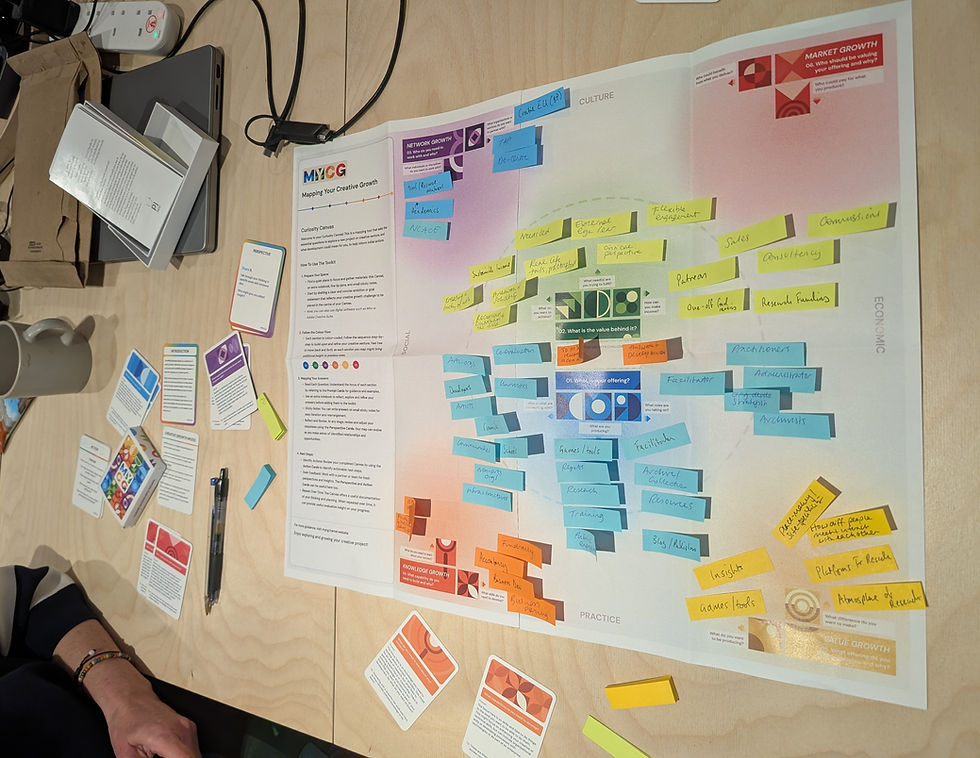
Image: Sophie and Henry using MYCG to think about COTT.
Michael Pierre Johnson is a Research Fellow and Lecturer in Design Innovation at the Glasgow School of Art. His research focuses on the creative economy, with a practice influenced by relational mapping and modelling. He developed the Mapping Your Creative Growth toolkit that has been used in various contexts, making complexity tangible, to assist in strategic development and individual learning. Sophie and Henry used the toolkit last year to think about COTT more broadly. Although it's not a card deck, it was such a fantastic tool that Henry spoke to Micahel about the toolkit for the blog.
Can you start by telling me the motivations behind creating the... would you call it a tool?
Michael Pierre Johnson (MPJ): Yeah, it's a tool, a method, a framework as well. Essentially, it came from my PhD, and it all builds from that journey. Back before I did my PhD in 2012, I had a few years in industry, having graduated in product design, really looking at the strategic level of design and the role design can play in more interdisciplinary forms of collaboration, achieving or addressing societal challenges. But I was a young 20-something professionally trying to tell people with a lot of experience in their industries or sectors how to change things, how to do things differently. I struggled with that framing. A PhD question emerged around what authority does design and design methods have in collaborative contexts that you're trying to change? Thankfully, I got a funded PhD, and the methodology I developed through that was relational mapping.
Initially, it was tracing the role design artefacts and design methods play in different collaborative contexts of innovation. Having developed that method, I found that question also resonated with the wider creative and cultural sector, the value of creative work in various developmental contexts. I was lucky enough to get a funded fellowship to apply this method in a wider context, and the pandemic also helped elevate the value and need of that approach, because a lot of artists and cultural organisations were having to adapt to this new challenge. This method, which essentially frames what growth and development look like for creative work, became a useful tool for a lot of creative work.
The partners I had were usually network-based, supporting a community of practitioners and organisations, and they were really keen to learn the needs of those communities. I had this double mutual benefit of supporting individual artists and practitioners to make sense of how their body of work relates to a new network or the ecosystem they work within. But also, that data became useful for organisations to know how to support communities better. Seeing and experiencing what was needed through those research projects pushed me towards developing a tool. But it's quite a complex method, and it took time to understand how to make it accessible.
Could you say a bit more about where your PhD funding came from to develop this tool, and how you’ve funded the project since?
MPJ: Yeah, because I'm primarily a researcher at an art and design school, the Arts and Humanities Research Council has funded my trajectory of research, from my PhD through to the innovation fellowship that developed the tool for the creative economy context. Since then, I've had individual projects, mostly Research Council-funded, that have allowed me to adapt and apply it in different contexts. Most recently, the Scottish Funding Council, which, through the University of Glasgow, was supporting entrepreneurship and spin-outs from Arts and Humanities research. That's the opportunity I took that brought it to the place it is now, and you've had a chance to look at it and try. I’ve developed it into a prototype and turned it into a product, designing myself out of its use. Up to then, I was very much a facilitator of its use. The entrepreneurship funding was an opportunity to take that experience, the different places I'd applied it, and design a canvas and card deck that took some of that knowledge and made it possible for other people to use without me in the room.
You started by saying you were wondering about the role of design in industry and collaborations, but also questioned your authority within that process.
MPJ: Yeah, it was a challenging scenario. I felt like I didn't have the authority to lead these conversations and processes. I felt quite naive, ultimately.
But then you frame yourself as facilitating. Something quite interesting for me in general is the idea of not being the person who knows the most in the room, but drawing out what other people know - facilitating knowledge rather than being an authority
MPJ: Yeah, for sure, and then the role a design method can play in that—just connecting up knowledge and relationships essentially between often quite disparate sectors or disciplines, and understanding how they work in a wider ecosystem, usually a project or an organisation. That has been really interesting, teasing that out visually in workshops and carefully crafted processes or programs. It can really facilitate meaningful connections and evaluation as well. That's where I try to position it: making complexity more tangible to help support strategic conversations and frame creative work. When complexity is made clearer, the value of creative work is made clearer and can be accounted for more easily. In some of the projects, it was very explicitly about developmental evaluation, or capturing the story of what's happened, capturing some of the intricacies to better understand what's important about a project.
That's one of the things I really love about the tool: a feedback loop where a context’s complexity is presented back to the people who are working with or within it, so that they can find their way through.
You say you started as a product designer, but then moved into design research and facilitation, and have now produced a product as a way to remove yourself from the process. This product has such broad appeal, but can you tell me more about who has used it?
MPJ: It's a tool to frame creative growth; what that means can be really interesting in different contexts. At heart, this product has been developed and intended to be meaningful for individual artists, creative practitioners, and creative enterprises, but that also extends to cultural organisations and, more recently, social enterprises that incorporate creative or cultural elements in their work. It's also part of creative collaboration.
Recent projects have been about sustainable development in Glasgow and the role creative practitioners like designers and artists are playing in various sectors. It's useful for those collaborations, for those who are not creative, to engage and better understand the value of collaborating with artists, as well as well-being development. Some of the most interesting uses have been supporting creative graduates starting their careers, taking that first step into professional practice. The tools can help them better understand and prepare for that journey, something which often design schools forget about.
Its framework is actually creativity-neutral. It is more about describing a social network around creative work, and the idea of relational forms of value that are going beyond the quantitative is actually proving of interest to quite a few people.
More recently, it's been applied to interdisciplinarity of all kinds, collaborations between scientists, engineers, and artists, helping to understand what happens when and what emerges through interdisciplinary collaboration. With the impact-driven agenda of quite a few universities, I've started moving into a space that addresses what innovation ecosystems more broadly look and feel like, and how each discipline plays a role. That's a longer-term research question, but I'm anticipating more versions that adapt their language or framing to other contexts.
Where would you like it to go? Could you speak a bit about your ideas on how that might progress?
MPJ: With the funded project that was trying to translate it into essentially a spin-out, there was a prototype, but there was also a business model that emerged with three levels. The prototype you got to use was first, and simplest, called the Curiosity Level, which is open source. It has the creative growth framework at its most explicit. It’s a mapping tool as a canvas and a deck of cards that help you navigate what questions to answer where.
But there are two other levels. The Professional Level is more of a suite of mapping tools and activities that use the framework in different ways. For example, there are additional tools like narrative mapping, where you really reflect on what constitutes the value of your work and the stories you tell about it, which audiences need to know about the way you do your work. Often, you need to tell different stories for different audiences. For example, to a community member, to a fellow creative peer or practitioner, to your customers or markets, and to funders, if it's around the impact of social or cultural benefits. Narrative mapping helps to focus on the value of one's activities. Network mapping is a tool that helps understand the network value of your activities.
Then there are tools like audience mapping, where you spend time on who your audiences are and what connects them to your work. There’s also journey mapping, which is like a visual form of action mapping, because ultimately, when you've mapped that kind of network, so what? What do you learn? What do you do with that? Action and journey mapping tools break down insights into next steps.
For example, in a sustainable development context, one project paired it up with the doughnut economics model. When you map your network and relational factors, how do they map onto existing frameworks like sustainable development models? When doing a project with nature-based enterprises - mostly social enterprises, but also some commercial ones like food-based businesses - in what ways is the work you're doing contributing to what the doughnut economics model calls social foundation: people's access to food, education, water? It becomes a useful tool to connect a business model with the complexity of value, to wider development models.
Then there’s the third and final Ecosystem level. This aims to offer training to those professionals or organisations that support creative practitioners and enterprises to establish a consistent way of framing creative growth in their communities, projects or places, and understanding how the value of creative work gains traction over time. If applied by whole networks, I believe this could help Creative Scotland, for example, design their funding programs and application processes (which are often really problematic). The amount of work they ask individual artists or microenterprises to do can put a huge strain on people’s resources. I see the tool helping this often difficult process become a supportive exercise that helps tell them what their project is trying to do. I'm really aiming to see if this can be a lens of translation to build better connections between those decision-making, policy-making support organisations and artists and creative work on the ground. That's the long-term vision.
You're an academic researcher who is producing a product that could be used in lots of different contexts. Do you think you might leave academia and become a social enterprise, or whatever legal entity that might be appropriate?
MPJ: The goal is both at the moment. At heart, one of my key goals on the academia side is to validate the methodology and some of the theory behind it, publish that, and make sure it feels like it has a robust grounding. That will allow me to take it to a wider readership and academic career beyond that. In parallel, I would love to set up an innovation centre for creative growth in Glasgow. I’ll call it that for now, but I think it'll need different names. It’ll be a hub for valuing creative work in various contexts of social, cultural, and environmental challenges, and it will become a place where organisations can be supported and collaborate. This methodology, in collaboration with other people and organisations, can help make that happen. There's a very place-based dynamic, but then you've got a hub which can connect to other place-based organisations and share knowledge. Doughnut economics, for example, has a global community that shares methods and practices about how they're applying the model to help make the changes it promotes. I see that as a useful model of knowledge exchange, and I would love a way to continue to develop frameworks and insights through relationality. A social enterprise could organise that around a space that employs people to really grow and develop these ideas.
Is Scotland a particularly good place to be working on this kind of project? With my very limited knowledge of the context, Scotland seems to be a fertile place to experiment with this kind of tool.
In terms of the Scottish context, yes, is the short answer. I think it is a really rich place for that. There are a lot of policy-driven, Scottish government-driven initiatives that are setting targets, and one of the opportunities here is that they don't really know how to measure whether or not they're addressing them effectively. The Scottish context is interesting because I really do feel there is a policy dimension that's really trying to achieve goals that align with the positioning I've got for this tool, but they're not great at evidencing or achieving those goals. There's a very narrow numbers game that policymakers look for, and actually, part of the challenge with making policy truly effective is how you mobilise actors and really show an understanding of the value and contribution different actors can play to achieving those policy goals. Scotland is a really positive environment for doing this kind of work because of the policy agenda around net zero and the Community Empowerment Act, for example. But one of the gaps in that policy agenda is understanding and evidencing how they're implementing the policy. I learnt this engaging policy makers while delivering a short project on innovation strategies and policies in Scotland in collaboration with the European Policy Research Centre. They emphasised how one of the core things of policy is how to mobilise actors towards wanting to achieve the policy with you, and the creative sector is self-initiating a lot of this, but policy doesn't quite know how to recognise that. It's about developing a stronger understanding of how to collaborate with creative work and the role it's playing.
Do you see a politics to this? You mentioned that it's “creativity-neutral”; does that mean it's inherently politically neutral, or do you have a political position in the way you've designed this and what you'd like it to be used for?
This, for me, also connects to being in Scotland, because of the creative and cultural sector, and the diverse context it works within here, such as islands, rural, forestry, a lot of the carbon capture economy, and nature finance. This is political because of the numbers game. Businesses can buy tracts of land, plant trees in an unsustainable way, as in monoculture, and it helps them meet targets, but it doesn’t come with any kind of community engagement. Many of these programs are not good for biodiversity; they basically cheat the system, to put it bluntly.
With the lens of creative work and cultural work, you can address some of those issues. So the political stance some of this takes is to value people and humanise such economies, even in the move towards sustainable development. I’m trying to promote or facilitate a collaborative agenda rather than something based on an accountancy-based economic view. The role of arts, humanities, and design is something I really, really passionately believe in. And that, I guess, is my political stance of saying we need to value this more, because you're going to have a much more flourishing society in the broader, simplest terms - seeing the economy not as a spreadsheet of numbers, but as relational. I don't say the economy is bad, it's more that we take into account a very narrow aspect of it at the moment.
Accountancy as a profession is a numbers game for finance. Bruno Latour says we need to get better at accounting for what matters as part of organising society and looking after the planet. This is one fraction of a method aimed at better accounting for what matters, towards the actual changes and goals that we have in society, which can be evidenced at a policy level. But we need more approaches like this to meaningfully achieve this.
This also sounds like the approach advocated by J.K. Gibson-Graham and the Communities Economy Collective. To get back to Mapping your Creative Growth more specifically, and in relation to this discussion, how to evidence what matters, how do you gather evidence on the method itself? How do you know this is working for the people and organisations that use it?
MPJ: I guess the best answer to that is collaboratively. While I've got evidence of its use in practice and projects which have had various forms of publication, in terms of this tool and getting out there to develop the social enterprise and make it accessible, there was an initial user testing phase. But really, there's an ecosystem level that I want the tool to work on. There are people trained up in the basic principles and the practice of using the model, and they feel ready to use it with their communities. With them, I'm trying to design the next stage of the funded development of this to take it to market. I train individual people working with communities and networks that aim to support, and then share with them or ask them to share data. We agree together a context for using the tool, and people are willing to share their maps. The learning comes from applying it. Different groups use the tool; one is a rural network, one is graduates from a university, and one is actually aiming to work with someone in Kentucky on their initiatives. It's going to have some global context, but also variations of urban, rural, and just enough evidence to say, right, here's the way it can work consistently across contexts, and here's the ways it needs to adapt for different users. It will be this constant cycle of development and learning. That's why I'm positioning it as a social enterprise, because I want it to be an open exchange based on the principles of this approach.
I love the idea of a constantly evolving tool, but then it is also a tangible thing that I've got a version of, for example. Are there aspects of the tool that haven't worked? Also, if it's constantly evolving, how can you know when it leaves your circle of control—that's not the right way of putting it, maybe. How do you know when it's left you and it's just being used out there in the world?
MPJ: That's a good question, and I think there are two answers. One is that there has been a journey of adapting the language. I think one of the achievements of the tool that's out there at the moment is that the card deck has accessible language, but that is still meaningful to creative, cultural organisations. That language was achieved in dialogue with different people. That's why this is the first version, which shouldn't adapt too much - here it is for creative growth. One version might need a different framing if it's for graduates. Some people may be less developed about what their model of practice is. In that case, you actually need more fundamental questions in there, and that's something I can do with the people I collaborate with on a graduate program-facing level. One version might be focused on sustainable development, combined with the doughnut economics model, for example. I foresee a whole product range around sustainable development. The core tool should be fairly stable and not move too much, but there could be a version two or version three that builds on the learning. There’s one connected to place development.
I think of it a bit like The School of Life, which has different tools and games. One focuses on relationships, one focuses on family, one focuses on being a parent. It's the storytelling and the evidence that can show the importance of certain markets or scenarios. That's what I anticipate happening going forward, all the way up to policy. What is the policymakers' version of this? What questions do they need to ask? I've already had a project insight on this that produced a principles canvas around innovation strategies.
The challenge I have is judging what the social enterprise should focus on to build a model that is effective and has traction in the market, and is sustainable, and what are my academic interests? I think your question earlier about which way I might go is apt; I might be forced to choose between the two. That's something I'm open to.
Did you start with an ambition to have something that would work on all these different levels and scales? I know you’ve been influenced by Latour’s Actor Network Theory, which can be pretty all-encompassing. There are lots of ways to frame that kind of complex theory. Were you interested in Latour’s work, saw possible applications, and then started working that way?
MPJ: Yes, but in my PhD, the focus was all about this one question about the role of design. The value of a PhD is that you get a community to share it with and learn as you share. Definitely, the principles of actor-network theory are all-encompassing, and the publications towards the end of Bruno Latour's life were very much about trying to address climate change and how our planet was not going to survive unless we better understood what matters: the role of technology, the economy and development. But initially, my lens was the role of design artefacts. Part of what the model frames, or what it's fitted to, is the creative economy. It's just that language change, the focus of culture and practice that's in the language of the creative economy. Through an actor-network theory lens, the language became focused on creative work. But the model is fundamentally neutral. “Culture” can be the culture of an organisation, the culture of a place, or it can be the culture of all sorts of things. When applying it, I found that project by project, it fit in other contexts as well. What one learns from the process is valid in different domains. The important thing is learning in dialogue with others. That's why it took time, because of that complexity.
This takes me back to the question of what authority design has. The thing I wasn't doing at the start was giving space for dialogue, for learning between people. When you're a business delivering design, you try to set up your clients to get on board with your processes or ways of working to maybe say: “Yeah, we'll learn with you about how this can work well for us”. The academic environment can necessitate an interest in how you innovate. It became a richer and mutually beneficial process, whereas before I was, more bluntly, naive and didn't have the time or space to learn in dialogue. The tool now provides that time and space. That's why I want to retain the academic work, because I really appreciate the space it gives to learn and develop new knowledge.
Actor Network Theory is a complicated formulation which can apply to many things (maybe anything). It’s a theoretical model that can help explain a context. But for me, there is something different about your tool. It's about a presentation of complexity rather than an explanation of complexity.
MPJ: Yeah, and especially when there's a bit of ownership over the complexity or mapping. Ultimately, it's a network of stories that people tell about the context they're working in. The stories are things to engage in, reflect on, and share with others. The goal, hopefully, is that through mapping yourself in this tangible and increasingly visual way, it supports your next conversations with people in that network and supports the understanding of what things connect in value. Your strategic-level storytelling improves. Actually, the outputs of one project were producing impact narratives for the project, and storytelling is key. The way I first presented it was as a methodology for telling stories, and sometimes not very interesting stories, but they can be meaningful stories for the right actors. That's always been at the heart of what this tries to do and why people have been able to engage with it.
That's a very nice way of framing it.
Sophie and I used the tool, and we loved it and found it very useful. But, as with Cards on the Table, people have used it, loved it, loved the sessions where they’ve played, but then go back to their desk and wonder, what now? How do you transition from that exciting moment of drawing out complexities and talking about issues, to then go back to work and take action(s)? Is this a concern for Mapping Your Creative Growth?
MPJ: In a word, yes, it was one of the bits of feedback we got from testing. A very small step towards addressing that was the addition of a set of action cards that help reflect on what emerged. They ask, What are the next conversations? What are the next tasks that this frames? What are the next resources you need to access? Things like that, and map out an action plan that lays these out. In my projects, this is the opening tool. I have had further maps. The most common version of it is three maps. One is the narrative mapping, where there's a reflective exercise of what the story is behind your work and its value. This is a good way for me to understand artists I meet for the first time. Then we'll map key objectives or goals, the network you want to grow, and then turn that into an action plan or journey map.
I've started engaging with the concepts of theories of change. This idea of outcomes that you're trying to have, that might be societal, might be for specific beneficiaries like a community, or even nature-based. Then, using that framework to start to identify what achieving those outcomes looks like. This mapping tool is part of something that can reveal those concerns, and you can put in a structure that is more widely recognised around theories of change.
The added layer to that is, if I could digitise this tool, that connection and dynamic between these different framings or models becomes even more effective. Then I'm anticipating, for example, in a nature-based context, you're going to get a lot of AI and computer-based evidence capture, data collection, linked to what we were talking earlier about—people trying to account more for things that don't currently get accounted for. This is richly qualitative, but the digitisation of these tools using AI could change the scale. Imagine if you had, let's say, 50 artists or organisations across the region mapping in this way. There's a lot of text-based data in that. Imagine if AI could help you tease out the learnings, the patterns, the stories that you're asking about. Digitising this tool could enable meaningful ways for people to act on the data. One of my challenges is that analysing the amount and complexity of data it produces is very time-consuming. I think there are ways to take it forward, to take that next step. From the individual perspective, when you're mapping at an ecosystem level, those are the opportunities I want to pursue.
Have you already experimented with using AI to analyse how the tool has been used, or help you parse out some of the data that's been collected?
MPJ: I have a project called Future Island-Island in Northern Ireland, where I plan to use AI. The Island of Rathlin is being used as a living lab for circular solutions. There's an idea that island life is very resourceful and is a very explicit context of needing to be circular. I've been mapping the projects and what's emerging from the ecosystems around that. There’s a need for some technical expertise to use AI, but we want to ask certain questions from the data we’ve captured using AI. I'm starting to learn how to do that. For the next, bigger project, which will collect a lot of data, I really want to make AI part of the project design and a collaborator within it. But it’s at an early stage, I'm afraid.
Do you have concerns about using AI? For example, the potential climate effects because of the amount of energy required, or general data privacy and ownership issues… are you concerned about any of that? Are there certain AI providers that you would want to work with over others?
MPJ: Good question. I think those concerns are going to be the live framings for the next projects. I definitely have concerns about its applications in my research and in the creative economy more broadly. I organised a seminar for PhD students in the creative economy, raising the questions of AI, and there were really interesting, really passionate debates about it; where the data comes from, what it's generating, and how it's impacting the industry in really negative ways for some people. There was this push and promotion of AI as a tool, and it could be really effective, but there aren't enough people who understand how it works and what impact it's having. That would be a concern in terms of really saying, if we use it this way, you want to be able to reflect and know what effect that is having, rather than just accepting its black box nature and moving on with it. That's something Latour constantly raises in question: do you fully understand its role in this wider actor network?
I'd say the Mapping Creative Growth is almost the opposite of a black box approach. It's totally opening up and making explicit how people can move through a creative process!


Comments