
Finding a Common Vocabulary: Cards for Life with Tom Mansfield
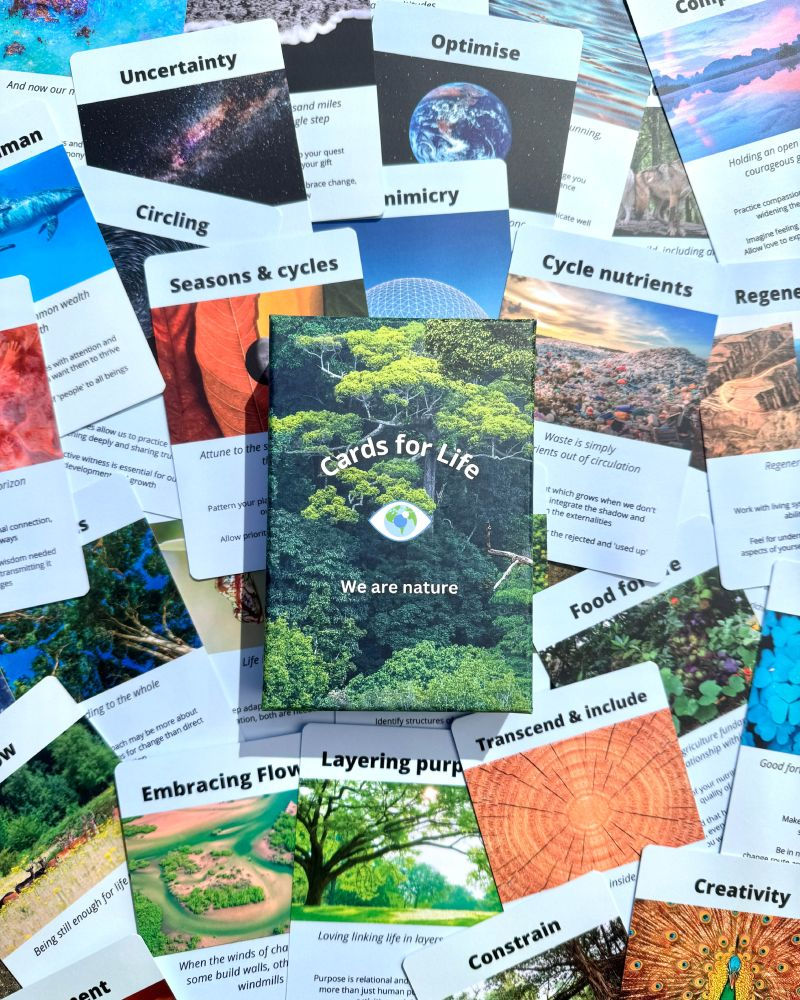
Image courtesy of Tom Mansfield & the Cards for Life practitioner community
For this post, we spoke to Tom Mansfield, founder of Pale Blue, who offers consultancy and training around planetary health and helps people ask the question, "How do organisations participate regeneratively in life-sustaining systems”? As part of this work, he developed Cards for Life, a deck of cards that shifts focus from objects to relationships. The cards aim to expand our use of language to think and talk about the connections between self and world, humans and nature, and to develop eco and systems literacy.
Thanks for taking the time to speak, Tom. Could you start by telling me a bit about your work and the journey that brought you to develop Cards for Life?
Tom Mansfield (TM): There are a few significant milestones on the pathway that've led me to Cards for Life. I grew up very connected to nature, in a very rural setting, so that's definitely in the DNA. My father was a rogue amateur philosopher who never really took an institutional path, and neither did I. I left school at 15. I was a bit unteachable, but very hungry for knowledge and learning. I've just recently learned the phrase ‘associative learning’, which means working with the right side of the brain, where painting, craft, or building work (which is what I did when I left school) is centred; a very tacit form of learning. I think that informs the cards, because that’s an approach to learning which is relevant in the regenerative, post-sustainability movement. You can explain what happens, but ultimately, people have to learn experientially and find their own way of doing things. Cards for Life are meant to support that kind of learning.
I'm retrospectively understanding these things. I worked in construction and then lots of different areas like film and public events. I ran a public events platform, bringing thought leaders together, starting at UK festivals like Secret Garden Party and Wilderness. After that, I continued running talks programmes for cultural institutions in London. That was my university, in a way, because it brought me into contact with people I was reading and wanted to learn about. The pattern that started to emerge there, which came from construction and helping people think about sustainable building, is that for a long time, I've brought people together to think about our relationship to nature, the future, technology, the big existential questions of our time. I've always been doing that from lots of different angles.
All of that work led me to sustainability, that's probably the best way to say it, and I ended up working as a sustainability consultant. I had been working on making the world more sustainable, but had a personal crisis. I had a long battle with addiction through my twenties into my early thirties, and my personal journey of recovery from addiction took me on an inward journey. I had to explore therapeutic methods and personal development. Coming out of that, I found myself with ideas and experience about making a more sustainable world, and an experience about making more sustainable worlds inside, in terms of personal development. That's really what's defining my work now, and the work with Cards for Life is where inner and outer work meet. I'm fascinated by that. I think I'm early in that journey, but I have some good tools to explore.
The connection you make between the inner and outer world is fascinating, especially in relation to the connection between a conceptual tool for thinking about climate and your practical, hands-on experience from working in construction. I appreciate the connection you’re making between the actual physical material we need to engage with, as well as the concepts, marrying that in your approach to the cards and your work in general.
TM: Absolutely, thanks for highlighting that. I think that's really it, and that's probably what's quite distinct about Cards for Life, and why people are finding them useful. They are very pragmatic. Someone said they lean towards action, and I quite like that. They could have been focused on a more abstract connection between inner and outer development, but there's a lot of real-world experience and appreciation for what it takes to project manage and build things, change infrastructure, and do that work of physically changing the world. I ended up running an NGO in carbon removal, and I noticed this inner-outer inquiry and wondered how to bring those things together. I went to study permaculture and Neuro-linguistic Programming (NLP). Permaculture for how we work with ecosystems and complexity, and NLP was a coaching and therapy toolkit which I benefited from and wanted to practise as a coach.
Could you tell me a bit about Neuro-linguistic Programming?
TM: The name Neuro-Linguistic Programming doesn't really give much away. It feels like a piecemeal toolkit, but it's a way of reprogramming relationships. Essentially, you find out what your relationships are made of in your way of constructing the world. It uses a technique for looking at the different senses. For example, is it a visual sense you're constructing a relationship with, a kinaesthetic one, or a physical one? By understanding those modalities, those ways we construct our relationships, you can change the volume on them and shift the emphasis. It's very creative, and that appeals to me. I had a practice for personal development, and something more systemic about working with complexity and sustainability. Permaculture principles are great, but they feel culturally niche and aesthetically unappealing to corporate and mainstream culture. So I thought: how would I repackage the permaculture principles and apply them more to personal development?
And that was where the idea for the cards was starting to emerge?
TM: I had a breakthrough when I was doing carbon removal work, and I realised I was designing workshop programmes for big multinationals, and everyone was talking about the world as if it were a machine. That's the language point. Phrases like "moving the dial on carbon", let's really take a moment with that, you're looking at a dashboard that represents the gaseous mix of the atmosphere, and in that metaphor, you're outside the world, right?
I also hear terms like “putting our foot on the accelerator”, or “putting the brakes on”, it's all based on oil-based technology language.
TM: Exactly, even the term “fixing the climate” makes it sound like a machine we’re working on. I got interested in ecolinguistics, a kind of ecological critique of language. Are we building or growing a community? Maybe some parts we build, but relationships have to grow, and that's cyclical; it's a very different process. I thought: how can I support people working in the really important space of planetary health, support people to have a more systemic language? To do that in a way that's not a prescriptive formula, not all worked out as a table, but more participatory. These words are lying around on the table, making their way into conversations, melting into vocabulary. That was the intention.
I noticed that people were there to save the planet and fix the climate, but why? It wasn't culturally allowed to say, "I'm in carbon removal because protecting and restoring life on Earth is a sacred mission." That would be deeply uncomfortable. Yet psychologically, we need to find coherence around a transcendent purpose, not the tonnage of carbon removed. People have children, or they care about the place they live, they are motivated by things like that. These intrinsic motivations were missing from the conversation, and the language was very mechanistic. Cards for Life are an attempt, an offering, to help redirect to a more living-system-sensitive language, and to help people connect their personal development with their work in the world. Not to judge people, we're filled with inconsistencies, because it's the nature of our civilisation. You might be working in carbon removal, and then at the weekend, spraying weedkiller on your lawn. These things don't join up. Of course, we can't solve all of these forms of dissonance; we'd go crazy. But it's not just about the fruit that's travelled around the world, or the weedkiller on the lawn, it's about getting in touch with how we feel about our relationship to these things. Finding ways of allowing ourselves to connect inwardly and be guided by that. Not trying to fix everything and be the ultimate green consumer, but spending time with our feelings about our relationship to the world through these choices.
I came to the end of the carbon removal work and thought: I want to come back to my offering to the world. That work had completed its mission, our funding finished, I knew it wouldn't be restarted. Lots of things changed for me. I moved from Spain back to the UK, and I joined something called the Bio Leadership Project, which is an online academy for connecting with nature and bringing nature's principles into our life and work. That was a really great container with about 40 or 50 people from around the world. While I was in Uruguay recently, I finally met May, who was in my home circle for the 2022 Bio Leadership journey. Around then, I started playing with the idea of some cards. I thought it would be a good thing to tinker with on the side during a year of webinars. It was never a grand plan, but it quickly became something I wanted to use with clients doing one-to-one work. My company had an offering to support people as a coach, to assist people in thinking about their purpose in the context of what the world needs. Not ostensibly environmental roles, but how personal stories line up with what the world needs at this time. I thought it would be great to have a big collection of ideas, from biomimicry and rewilding to some of the principles we find in permaculture and the dynamics of living systems, and see how these things come together. And then I came up with a design for the cards.
It's a fascinating backstory. So, more specifically on the cards, can you tell me how they work? When people play the game, what goes on?
TM: Every card has two sides; one side has a word or concept, the other a picture depicting that concept, or a metaphor for it. There are three sets of cards in the deck: Dynamics, Being, and Doing. Energy is the first card in the Dynamics set. The Dynamics are things we see in all complex systems, from energy to disruption, to growth, attraction, potential, integration, and so on. There are 24 cards in each set, so 72 in the deck, quite a large vocabulary. The gimmick is that every card has a personal and a collective side. So, where are you drawing energy from? The prompts on the card speak to this. Then the other side directs that concept outwardly to a larger system, so you have the inner and the outer. That direction takes the form of a series of questions, with related concepts at the bottom. It might be: where is the system drawing its energy from? So this helps people constantly dance between the inner and the outer. All of the exercises for the cards invite people to look at both dimensions and ask what their potential is. What's the potential of this situation? How is your organisation, your family, your community, your relationship working? One of the questions is: what if we switched from solving problems to realising potentials?
There are four exercises designed for the deck. One is called Personal Inquiry, where people draw a random card from each of the three sets. It looks a bit like a tarot exercise, an association I've tried to keep distant, but it is essentially sense-making with three cards around a personal challenge, or a time of transition, or a situation people want to bring new thinking to. They're doing relational thinking between the cards, drawing one from each set: a dynamic they could work with, a way of being that could resource them, and a way of doing, an action direction that could be more life-centred, or more dynamic.
Are they choosing which cards they want to work with, or is it random?
TM: In that exercise, I invite people to take a random card. If we choose, we'll go towards something we know, or something we have a story about. Introducing random ideas is very effective. That exercise is different from the other three, which are group activities.
The first group activity is a circle practice. Everyone draws a card, which can be random or chosen, depending on the context. If it's a more intentional gathering, bringing a team together, you might say: choose a Being card that represents a way of being you'd like to bring into our work together. If it's a check-in or a group of random people, drawing a random one is easy and helps people get to know each other. The Being cards are things like belonging, presence, gratitude, slow, and steady. They're a synthesis of principles from wisdom traditions like gratitude, compassion, and presence. But also some more contemporary ideas, like discomfort. What is our relationship to discomfort? Are we going through it or avoiding it? They all have a regenerative flavour, chosen because they're ways of being that can help us be with the dynamic change of life, rather than trying to control it.
The next practice uses the Dynamics cards, and this is probably the heart of Cards for Life, or gives the strongest sense of its flavour. We take a dynamic like potential or synergy, and do a nature observation activity. People go outside or look out the window and look for as many examples of that dynamic as they can. They often start to include human developments as well. Disruption is a house falling down, but it's also a plant growing through a wall. This exercise is getting people to create their own metaphors for how change happens in the world, and then bringing those back to a group conversation about how change is happening in their lives. I love that one, because you're not offering people prepackaged metaphors. They have to make their own observation, and something is happening there, a new neural pathway, and they're creating a story about what they've seen and how it relates to what they're experiencing in their life. So they might say: our company is like this plant growing through a wall, or my relationship is like the house falling down. It gives people permission to give themselves counsel. It has this ecological flavour: if we worked more like a living system than a machine, we could embrace change and work with it in a more productive and healthy way.
The Doing card activity is a mind-mapping exercise, where we choose the cards that express the kind of action we want to take in the world, or the impact we'd like to have, with life at the centre. It's more of a design process. None of these are rules-based games; they're talking prompts, thinking aids. The Doing card activity, which I call the Regenerative Vision, is a vision for something. Some people have done it for a family holiday; it could also be a new product or venture. I do it a lot with founding teams. I really like this activity because it helps people create a vision statement, but it's also very pragmatic: every card prompts them to write a question and an action they're going to take. You have this high-level vision, but you also have at least three discrete things that are going to happen next week or over the next month, things people are going to do to bring that vision into the world. It becomes a living inspiration board, often with a rolling set of to-dos.
The sequence of these exercises brings out how we connect to ourselves and each other, and connect to the living world and its processes, then our action can arise from there in a way that's more in harmony with life. One note on the cards: they don't mention climate, or the environment, or any of these more politicised concepts. They are simply cards for life. I remember someone once asking: Are these cards for life, like the environment, or how you're living your life? And I said: What's the difference? They try to explore the space where those things meet.
When people work with the cards, they get quite consistently confronted or challenged by them. There's a card for entanglement in Dynamics, a way that life knits itself together, like mycelium fibres and tree roots, which is the image on the card. At a cellular level, it's quite hard to say where the boundary is, because they're interwoven. A number of times, I've seen people take that card and frown, feeling like they got a bad card, which is always interesting. Then they go and observe things, and they often say: nature's messy, but my life is very organised, I'm super clear about what I do and when. At some point, that idea gets disrupted by the card and their observations. I've had many breakthrough sessions in circles where people go from an orientation of control and predetermination to one of surrender, which requires faculties like creativity and embracing change. It's not about denying that sense of control; we all need some of that. But this whole set of cards is about helping navigate the complexity of the world, which seems to be increasing in significant ways.
Biological systems have mastered complexity, integrated diversity, and persisted through constant change. From the conceits of modernity, where we have it all worked out, the cards give people permission to recognise the areas where they don't have it worked out. There's a lot of liberation in admitting that, and also a lot of potential, growth, abundance, surprise, and enjoyment. It's not just a humbling exercise; it's an empowering one. That experience of letting go, embracing uncertainty, and finding liberation and empowerment is the common thing people experience.
There's also a magical experience in the cards, one of serendipity, or synchronicity. People draw a card and are surprised that it relates to what's present for them at this time. There are different ways to explain that, but the important thing is that people are having an experience of a larger system of intelligence, resonance, or attraction of ideas, whether psychological or spiritual. That experience, I think, is really valuable for people, and I see it consistently. These are people who wouldn't go to astrology or do a tarot reading, and there are no pentacles or priests, no system of symbols you have to subscribe to. It's just things like collapse is a tree falling down, things go through collapse. That makes the experience more accessible, and that's an important thing.
This makes me think of so many things. There's a philosophical perspective that would say all conceptual problems can be solved externally, and the answers we're looking for are actually out there in the world. It's not an internal battle that we have to solve to have an external result; it's all out there already. With COTT, I’ve noticed similar trends you're alluding to. The juxtaposition of cards allows players to see connections between things in their life and on the cards, and this shows them a path to seeing something in a new way.
You mentioned Tarot. I think what's interesting in that format is less the idea of higher or mystical powers, but rather the practice of making external connections, which is found in a lot of religious practices, but what’s also happening through the idea of metaphysical practice is a social or community-based practice, which is an important aspect of it.
In the 2019 Uehiro Lectures, American philosopher Elizabeth Anderson talks about people doing participatory democracy workshops in Texas. These can be highly partisan processes in which, she notes, when the word "climate" is used, some people reject it immediately because of the term's association with a certain kind of politics, but if the facilitators talk about "fluky weather" — a local term for bizarre or extreme weather events — people engage. The language is depoliticised, which then allows for a political engagement through language. Cards for Life seem to embody a similar associative approach.
Another philosopher, Cora Diamond, has an essay called Knowing Tornadoes and Other Things. She carefully outlines that you can understand a tornado as a physical process that a meteorologist can explain in terms of forces interacting. But you can also know a tornado in terms of what it's like to live in a place that's had a tornado rip through it. They're both important to understand what tornadoes mean to human life. They're not the same kind of knowledge, but they're not conflicting knowledge either, just different ways of understanding a phenomenon. I think this idea of externalising relationships through language that people might feel distanced from, to then get them closer, putting it in terms that are helpful for them, relating knowledge and phenomena to practices that are closer to their lives, is really fascinating.
TM: Totally. Thank you for highlighting that, because those are the essence of this work. I really like the way you talk about finding external connections and essentially connecting to the world. If we put it in that framing, that people suffer disconnection, in the most general sense: from other people, living systems, their community, the place they're in, the things they eat or wear or use are made, from themselves even. This practice of reading the world and seeing relationships between what's present for us and what's out there is really powerful. It is the pursuit of reconnecting in lots of different ways.
What you mentioned about tornadoes highlights this tacit knowledge, this experiential knowing. We can know about tornadoes as meteorologists: model them, read their history. But living in a town that's been hit by one, having your possessions removed by a tornado, that's another dimension of experience, one that can be shared but is ultimately unique to you. Modernity and the era of modern, reductive, analytical science that takes things apart to understand them, more like the meteorological view. But actually experiencing something is a different kind of knowledge. Experiential knowledge is more and more needed or wanted at this time. Another way to say it: the difference between sustainability and regeneration is that sustainability feels more like knowing about the tornado, and regeneration is experiencing it. That's a really powerful metaphor for this time of climate change.
Cards for Life are taking off because lots of people have come from sustainability to what's being called regeneration, actually restoring life, and including our participation in that project, too. There's a changing approach. People are trying to map out regeneration, rather than saying: Well, regeneration is something that can't be defined. How can I convince my clients they need it if I can't define it? Cards for Life have cut through that by saying: here's a practice to live and behave more like a living system and less like a machine. You can give your friends, clients, and family an experience of that by working with these cards. We're not learning about regeneration but co-defining it, as a practice, not something that can be completed. That's really nice. Wisdom traditions didn't expect anyone to master the I Ching in a week. It's a lifelong practice. 64 hexagrams, an unbelievable number of potential combinations. I don't think Cards for Life is equivalent to the I Ching, but the number of possible combinations is vast. I got asked by a designer friend, Caroline, at the start of the project: "This looks great, Tom, but what about just the top 10 cards? Couldn't you distil it, make it really quick and effective?" And at that moment, I felt a confidence rise, because I realised that's exactly not what I'm trying to do. I went and looked up how many unique three-card combinations there are of 72 elements — it's something like 60,500. So you could do 10 unique readings every day for 30 years and still be two-thirds of the way through the combinations.
That's also assuming the same person is coming with the same attitude and context every time, but that element is potentially infinite.
TM: You could have the same set of cards every day, and it would still be different, because life is changing around you.
Some of the things you've been saying make me think of an (imperfect) analogy that rolls around in my head: Modernity, or modernist modes of thought, are a bit like people seeing the world as a puzzle that has either been solved or is there to be solved. We're on this route to having the puzzle of the world or life, or society solved: all the pieces in place, mapped, controlled, put where we want them. What's interesting about what you're saying is that you're using cards, which are a bit like a puzzle, to disband that idea. Using a puzzle to show that this can't be the way it is.
TM: I'm really going to carry that with me, that's brilliant. It helps articulate something I haven't quite found the words for. I've come close to it by talking about how the left brain grasps objects, arguably where the analytical and reductive orientation comes from, and by having a set of cards, people feel like they can get on top of this, learn them all. But of course, the relationships between the cards are too vast and changing to map or learn by rote. It appeases that part of us that wants to solve the puzzle, and then people realise they can't, but find another way of practising and acting.
The whole point of puzzles, the reason they're appealing, is the doing of them. The appeal of a picture puzzle vanishes the moment you've finished it. That's not what they're for. They're for finding the pieces and putting them together.
To change tack slightly, could you tell me how the game is funded? How do you approach that side of it?
TM: It's all self-funded, I'm proud to say, so far. I'd like to try and get some grant funding or sponsorship for some aspects of the project, but I've taken a post-growth approach to this business. The big vision: it started with a card deck, and then a basic facilitator training that I run, which has been effective at funding the trips I've made to set up partnerships in other countries. The core package is this physical product, plus a training service to support people in facilitating the activities. That's been running for two years; the year before that, the cards were just on sale.
To print the very first version, I made a prototype, self-funded, demonstrated it to a few people, and some of them said, "Are you going to make more of these? I'll get a set." I got friends and colleagues to commit to covering the print costs for about 20 packs. I produced more and sent them around the world for people to practise with, as long as they committed to giving me structured feedback. I used that to refine the first version. At that point, I intentionally decided to do three iterations rather than just a prototype and a finished product, adding three cards, one to each set, three times. That was a bit difficult, because it felt like an unfinished product, and people asked about upgrades.
Through that iterative process, I got a good first version. A leadership training organisation then sponsored me: they said these were really useful and they'd like to use them with their leaders, a cohort of about 25 people a year. They bought 20 packs on a pre-sale, and that, with an introductory workshop, allowed me to produce the first 200 packs. So I had some stock, no profit. I put them on sale, gave upgrades to the first adopters, and they were doing workshops for communities, for clients, using them with friends and family. We had a WhatsApp group, full of life right from the beginning. Then one organisation adopted them, then another leadership training organisation pre-bought some packs, which helped me produce the next batch. It was starting to work.
I realised, it's not about selling number of cards. Even if I sell 1,000 a year, the business isn't going to sustain me on its own. Then the training came in. Practitioners started saying they'd like to go through the exercises rigorously with a group of other facilitators. I did the first training course at the end of 2023, called Thinking Like Gaia, which was a six-week online training with weekly sessions. We go through the four exercises and do a lot of self-review and external practice. That's been really successful, fully booked every time. About 15 people on a course, and there have been 12 cycles now, plus several adaptations for organisations internally. I've done staff training at the Eden Project, Wildlife Trust organisations, and a number of corporate workshops, including fashion companies. ASOS ran workshops for its diversity and inclusion team. For them, there was no sustainability-environment connection, but they thought: diversity, nature, those things go together, so let's have a nature process.
You've alluded to different kinds of groups that use the cards. Have you been surprised by any groups who want to use it? Relatedly, there is a political perspective that comes with this. Has a BP, for example, done your workshops?
TM: That's a really good question. I haven't been surprised in the sense of oil and gas companies, the sorts of organisations I used to work with at the Carbon Removal Centre. I’d like it if they adopted the cards. The most surprising one at the moment, which is an exciting step up, is the Swiss National Supercomputing Centre, which has a very diverse staff from around the world. It's the largest supercomputer in Europe. They do climate modelling, but also model drugs for pharmaceutical companies and hire out their computing power to all kinds of organisations. Their head of culture and transformation has been using the cards for a while, and she said she really wants to bring this thinking in. Structuring that engagement is an exciting expansion of the work. It's a very technical organisation, and they're all supercomputing technicians who are analytical, reductive. Rational thinking is their strong suit, and the cards are being seen as a tool to support the human, people-to-people side of their culture. That's a really exciting challenge, and it's different from wildlife trusts or the Eden Project.
In terms of who else is using the cards, there's been a nodal strategy, training the trainers. It's primarily for coaches, consultants, and facilitators, with subgroups of educators, architects, and designers using the cards a lot. It's been wonderful to see that nodal strategy work, because they take the cards out to many different kinds of groups, communities, and businesses. A number of those then come back and ask if I can come and do something with our organisation, or train some of their staff? I wouldn't say there's been a surprise in the sense of organisations whose values feel far from the cards.
Someone has referred to the cards as connective tissue, and I really like that phrase — connective tissue for the regenerative movement. They're providing a common vocabulary for people taking this approach to regeneration: not predefined, but co-defined with others, in a practice-based way. They give people a sense of shared practice in what is a fairly unmappable approach. The organisations that tend to adopt them are those that say they want to operate more like an organism than a machine, or they want a culture that's more life-centred, more able to deal with change. The easy adoption over the last couple of years has definitely been at that edge.
This also makes me think of something we often consider with COTT: people play the game, they have a really productive conversation and get to the core of what's going on, and then the game's finished and they go back to work, back to their desk, and nothing changes, they just go back to normal. How have you thought about that? Is there a way to mitigate it?
TM: It's a huge challenge, and a great question. Culture change work is hard to measure in discrete outcomes, and the hope with the cards is that they melt into the background over the coming years, becoming part of the vocabulary. One fairly intangible change I do notice from the Bio Leadership and Cards for Life practitioner communities is seeing articles that people write on LinkedIn, and I think, that's a card, I can see it in the vocabulary. I don't mean to claim that without the cards they wouldn't have used these terms, but there's a sharpening of the relationship between these concepts that has certainly been supported.
In terms of impact, there are some really great stories, and I'm hoping this winter to actually catch up and put some case studies together. There are some light versions, but it's time for more rigorous write-ups of the direct impact. The Seasons and Cycles card directly initiated a conversation about menstrual leave in an organisation, which then created a policy for it. The cards permit things that are close to happening, ready to happen, happen. They de-risk those conversations; it's not the agenda of a female employee, it's on the card, it's come out, it's on the table. The Cycle Nutrients card led to circular economy policies. These are the Doing cards, which lean more heavily towards action. There's a new set of exercises and a workbook that I've designed for the organisation I'm currently working with. A series of templates where people use the cards in these exercises, like using the adaptive cycle, where we create that on the floor and use the cards to talk about the phases of it. That leads to concrete actions for enabling change at different phases of the cycle.
The big vision for Cards for Life, as a vocabulary, is for what I call regenerative literacy, or perhaps regenerative familiarity. It's to support better conditions in terms of language for what I see as the next phase of the project: regenerative innovation. I see the cards as a precondition to help people become more familiar with these terms and more adept at using these concepts. That's the starting condition for coming up with genuinely tangible, concrete innovations. I'm interested in enabling those innovations. We'd first complete the global spread of Cards for Life to a degree, and then collectively start focusing on innovation. These products will then be in a mature place where we can really direct them towards outcomes. I take quite a long-term view on the tangible outcomes.
The literacy thing is interesting. For me, that has a connotation of how well people can read things, and as someone who's dyslexic, that jars me slightly. It makes me think more of a traditional notion of teaching rhetoric as a skill: how to articulate yourself, be a good orator, make arguments, and think through speaking as much as being able to read a situation. It's not just a vocabulary for someone to learn; it's a way to articulate, which is not just a set of words. It's an approach to how you use words as much as the words themselves.
TM: Articulation is the key concept, regenerative articulacy. Not very catchy.
I'd like to quickly go back to what you said: someone at work can talk about the card, not their own menstrual cycle. They can talk about the card, not the person they have an issue with, not themselves. We've found that a lot with COTT, players can approach a quite difficult conversation because they can talk about the card, not the person. A diverting form of mediation.
TM: Exactly. Having the idea in hand on a physical piece of material that you can put down and pick up, there's something very enabling about that, and de-conflicting, for more difficult conversations. Cards for Life, like Cards on the Table, help people have a better quality of conversation, but they also do something to empower people's thinking.
Are there any other games or practices that really influenced the design?
TM: The inspiration for Cards for Life has been systemic, gathered bit by bit over the years. I think it's quite original in some meaningful ways, but there’s a long list of books that have directly inspired me: Fritjof Capra & Pier Luigi Luisi, Daniel Christian Wahl, Robin Wall Kimmerer, Tyson Yunkaporta, Donella Meadows, Joe Brewer, Neil Theise, Paul Hawken, Arran Stibbe, Laura Storm & Giles Hutchins, Jeremy Lent, and finally Adrienne Maree Brown.
Brilliant, thanks for sharing all of those people and texts that contributed to the thinking behind Cards for Life. Would you like to add anything else?
TM: The last thing I'd like to say, which feels quite important, is the global scope of this project. I've been on tour in China with the Chinese Cards for Life. They've launched in France and Brazil, there are 12 languages in translation, and I've just had enquiries in the last two weeks for Korean, Finnish, and an Arabic partner. There's a community of about 30 translators globally, and that's all happened in the last year. This approach to empowerment and a decentralised, place-based approach has led to a stewardship model where we're co-founding an association that will own all the different language versions of Cards for Life and license them out to regional partners to run their versions of the training and the card decks. That's stimulating cross-cultural dialogue. Jennifer, who created a Brazilian version, and Xinling, who created a Chinese version, are now having conversations about regenerative potentials and the relationship they'd like between China and Brazil. That's really exciting.
I've chosen to go to East Asia, East Africa, and South America first, so this doesn't default to a European regenerative conversation. The hope is that those influences are stronger first, to create a more balanced global conversation about what's universal and what's different, and to reflect the shift from a unipolar to a more polycentric world. When I think about the BRICS nations, there's also a micro-macro attempt to talk about the future of the world and regenerative potentials in a way that connects to what we see shifting politically and in the global community. I'm feeling really passionate and excited about that.
Did you approach that through the Bio Leadership programme, using the global connections you made there to disseminate the cards?
TM: Bio Leadership has been a huge catalyst; it's very international, and a lot of the test packs went out to people around the world. There's also a sense of unlearning and decolonisation that are part of the regenerative mix. It felt important to have a post-growth, decolonial approach and explore how those things might show up in this project. They all stem from a living systems approach. For Cards for Life to be a global conversation, it can't be an export from the UK to China with a straight translation. It needs to find a steward: someone who can take the essence of this project, grow it in Chinese soil, and then work to keep coherence between those two things. That's the good creative challenge, and it seems to be working so far. Fingers crossed, we will establish an association together and hold that coherence.
So an association isn't legally formed yet, but is on the way?
TM: That's right. There's a licence fee model. Pale Blue licenses the cards, but the license includes a clause requiring the licensee to be a co-founder of the association. We will then reissue the licence as an association decision, and can adjust the terms as they need to evolve. Everyone's on board for that so far, and it's one of the stipulations for doing a translation. People take time to really integrate the concepts, create their own version, and, through that process, build a lot of trust and knowledge about working together. We've already taken a step into a more professional venture.
I really like the idea that they're not doing it for you or for themselves; they're doing it for a network you're creating and facilitating.
TM: I'm going to do this tour, which sounds and feels very glamorous but is also quite hard work. I'm going to these other countries to activate the cards with their new steward in their language, and I find I'm not in the spotlight much at all because I don't speak Chinese or Portuguese, and I didn't create the version we're launching. It's a few words from the founder, and then I step into the shadows. That's been quite humbling and really positive, because I definitely don't want to be a guru. I've been in organisations that have suffered from a founder that can't let go, and I think that's already built into how this project is going to scale out. My core work in English with the cards is growing, and that gives me enough energy as an individual to feel really supportive and generous about sharing it. I'm learning about that balance all the time, and it has a lot of edges for me, but it's a great journey to be on.


Comments