
Which Way is Up? With Hannah Rennie & Shepherd Manyika
- henrymulhall
- Nov 22, 2025
- 15 min read

Which Way Is Up? workshop (2024). Image: Sam Wainwright
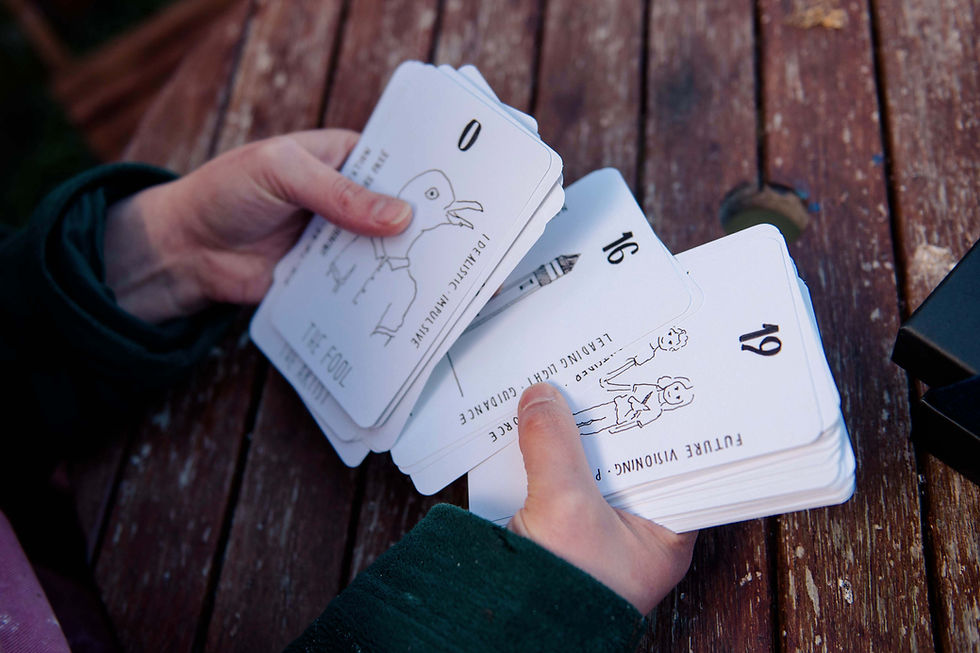
In this post, we speak to Hannah Rennie, an art teacher at a Girls’ Grammar School in Sittingbourne and Shepherd Manyika, an artist and lecturer at Saint Martin's. They collaborated with Cement Fields and Freelands Foundation to produce Which Way Is Up? as part of the project From Other Gardens. This set of cards offers art teachers, students, artists (or anyone) a resource that can help get past those difficult moments when a creative or collaborative process gets stuck.
How did the two of you come to work together?
HR: There was a termly meetup with all teachers in Swale, where Cement Fields - an external art organisation - were promoting a project to work with an art teacher in a secondary school. It seemed like a really exciting opportunity, so I contacted them straight away, and it all went from there.
SM: I've worked with Cement Fields before this project. As the project was coming together, I was invited by Hannah and Dan to join. They were looking for an artist to work on the project, so I was brought in to collaborate with Hannah.
Was it an artist's residency in the School?
SM: No, I mean, yeah, that's interesting. Maybe it was residency, it's always interesting how these things are named. What exactly do you call it? Maybe it was a residency, because it was a year-long, or maybe even longer. I was there for that length of time to develop a resource, which eventually became the cards.
Were you teaching while you were there? Teaching art classes while also developing a project? Did you always know it would be some cards, or did they come from responding to the context?
SM: My role in the project was to come in as an artist; that's maybe a good way of clarifying things. I see my art practice and my teaching practice as one and the same. So it makes sense for me to be in that kind of environment where teaching and art making are involved. I went in as an artist who was collaborating with an art teacher within the school, and my role was to design some exercises for the young people to respond to. For example, I introduced sound as a practice sound. We did some drawing exercises, about portraiture and things like that.
But also having conversations with Hannah about how to design something as part of a workshop that works within the classrooms. Often, an artist comes, makes some noise, and then they go away. But how to make it work for the classroom, in collaboration with the teachers, is not always considered, whereas I think this allowed for a wider, more considered conversation to happen between the two of us about what we were doing.
Brilliant. And Hannah, is it fair to say that art has been and is being marginalised in schools? Do you feel that?
HR: Absolutely. I'm aware of it, but I think I'm very lucky where I am. We have a Headteacher who has an understanding and a passion for the arts and the importance of creativity in education. We've got support from her, which is great. But longer term, I'm obviously concerned about what might happen. I mean, this was a fantastic opportunity for Shepherd to come in and work with the students, and I think it was really beneficial to that group of students that we worked with, for sure.
Freelands Foundation funded this collaboration, and Cement Fields organised/facilitated it. What do you think about the fact that initiatives like this aren’t already funded by the government?
HR: Little priority is given to initiatives that centre on play and experimentation. We’re so wedded to output-driven approaches to learning. There’s a ubiquity to functionalist pedagogy in terms of the state’s approach to education, where the goal is to homogenise students and prepare them for the discipline, order, and routine of the workplace.
Whilst I’m delighted that arts organisations and funders like Cement Fields and Freelands Foundation are interested in developing approaches with a different set of values, it’s frustrating that they are very much ‘plugging the gap’ of what should be a much broader and more commonplace effort.
Let’s talk about Which Way Is Up? Could you tell me who the game is designed for?
HR: It's for anyone and everybody. It came about because when Shepherd came to the school, we had two different things going on. We were working with the students to create workshops for them, and we took them out to The Towner in Eastbourne. We also needed to create a resource. The two activities bounced off each other a little bit. Originally, we thought we could make some cards that you could go into a museum with, that both teachers and students could use as prompts. But actually, that doesn't work, because depending on what you're looking at, what the exhibition is, the questions aren’t always relevant.
It brought about some really interesting conversations. In the end, we decided that the cards should be for anybody and everybody, no matter your background or age. If you are doing some artwork and you are struggling, you can use the cards as a prompt to help you. Equally, you can turn a card over and use it to shift the process you're doing. The cards make you think about what you’re doing, take a break, and then restart.
SM: That thing about accessibility is important, which is what we started from.
The cards initially were about the classroom and the art teacher. At the start, we were thinking more in that way. As we went out into the world and started looking at artworks, we started to think about the young people themselves and how they engage with the world and most specifically art. Then we started to think about encounters outside of the classroom. Some parents might not be so understanding/open to what an art practice can be, or how to read an art exhibition. We started to think about how the cards could help with that.
The cards would help in opening up a wider conversation that's not necessarily just about how paint works on a canvas. But it could be more about what we are looking at. The cards would start a conversation. How do we open up the conversation, instead of closing it off? This would need accessible language, nothing too academic. Not that there’s something wrong with academia, but it can close things off. You have to know it in order to understand what's being said. The cards aim for a more open and relaxed conversation.
Yes, and people sometimes don’t realise when they’re using arty or academic language. Did you imagine the cards to start being used in a classroom and then having a rippling-out effect? Many community-focused projects might work initially with a focused group, often young people, and then spread to their parents, and then out to a wider community. Did you have that in mind?
HR: We were coming from two different starting points, or three, really. Shepherd was working as an artist, then you have the teaching side of things. There's no right or wrong way to use the 36 cards in the pack. You could potentially put them on the table and get a child to choose one as a starting point at the beginning of a lesson, as a starter.
SM: We're talking about stuckness as well, isn't it? What do you do when you're stuck? You've started doing something, maybe a painting, and you can’t move forward. I think one of the cards just says, take a break, sit down, go for a walk, or something. Sometimes a simple action stops you from overworking and allows you to step back and look at something with a different perspective.
In the classroom, or as someone leading the classroom, if you find yourself stuck, you can pull out one of these cards, and it might help you think of the next step. Or as Hannah was saying, it could be the start of something. You can start with the cards, or you can go back to the cards halfway through working, or at the end.
HR: We used them to help some of the sixth formers feel more independent. We talked about how different it is when you study art at secondary school, and then you go into the big wide world. It's very different. Even at university, the kind of expectations of you are very different. It's odd, actually; there’s no bridge between those two.
SM: We're talking a lot about the cards as a bridge. In secondary schools, people use a certain way of looking and talking about things, or even in primary school, and that language continues through university and into life. I feel like the language used through the various stages of education can be disjointed, and in some cases, this fragmentation of ways of communicating from Primary to University makes participating in society and educational spaces challenging. Most young people only encounter language like “pedagogy” or “juxtaposition” once they're in university. It's hard to learn that stuff at 18 or 19 when you haven’t been exposed to it. I guess what I am trying to say is that the language used in education should be accessible. This is not about simplifying things but using these big terms earlier on in life so that they don’t seem so complex when encountered later in life.
One of the things the cards do really well is highlight a difference between
fulfilling a task that you've been set and trying to come up with your own tasks. Maybe a key part of developing a creative practice is to develop tasks or problems that you can find solutions to.
A classic set of cards for creative practice is Brian Eno’s Oblique Strategies. It's basically a pack of cards that gives prompts to do something different when you’re stuck in a creative process. The cards in Which Way Is Up? have two sides, and one seems to ask the player or user to reflect internally, “what am I doing?”, and the other externally, “what can I do differently?”. The invitation is to think about yourself, but also to think about what could be done differently in the world. These two prompts can encourage critical thinking in the player.
SM: We thought of it as one side is stop, one side is go. Stop: Look at yourself, look at what you've done. Go: What could you do next? What else is there that can influence whatever you're doing? It's not so much about internal, but about stopping and assessing what you’ve produced, and thinking about another way forward.
But as you were describing it, I just thought about the cards as a way of preparing yourself for a crit, which is what happens with most pedagogical art spaces. People gather around and look at each other's work. What is it that we're seeing here? What is it? What is it doing? What could it do? The cards could give you some autonomy to do some of that yourself, on your own. You make notes, you make drawings, you make a pattern, you walk off, come back to it, then you have an understanding of what the thing is. Doing that on your own will then make you better equipped to talk about your work with other people. Maybe you’ll have a greater understanding of what you did, without having to feel, because those questions can be quite disarming. When someone comes to you and asks, “What does this mean?” or even “Why have you used red?” It can be difficult to talk. The cards show it's just a series of words, you can read them and think, I can do this for myself, I can figure it out myself. Then, when whoever comes and asks about what I'm doing, I've already thought about it. You're not writing an essay about the work. You're doing it while you're making the work.
When I was at art school (university), group crits certainly felt like one of the most important parts. Students who were confident in articulating their practice often seemed like the best students. Still, the ability to talk about one's work isn't necessarily the same as having a strong artistic practice. When I was at secondary school, the idea of talking openly about my work was absent. Teachers talked to students, but students didn't talk to each other about their work.
SM: We're not given the tools to do that. If I think about my experience, I don't remember talking to my peers about what we were doing in art or CDT. In all those creative areas, we just made things.
With these cards, after the teacher talks to students during class, there's an element that could carry on into the playground among the students. There are questions in the pack that are a little bit wider than just conversations for the classroom.
HR: My experience is exactly the same as yours when I was at school. I think now we’re teaching the students to talk more about their work, which I think is just a good life skill: communication. Public speaking, even if it's done in a safe space, gets students used to talking about their work. That’s just so important.
Art classes or art education can offer something much wider than is generally appreciated. The idea that a student makes something and then talks to their peers about what they’ve done has huge confidence-building potential. I think this is why the lack of funding towards arts education is so ridiculous.
Which Way Is Up? was funded by Freelands Foundation through collaboration with Cement Fields. Could you tell me more about how that worked, like how many packs were made and who received the packs? Also, is there an ambition to get more printed and to make them more widely available?
HR: Through the funding from Freelands, Cement Fields were able to set up the collaboration between Shepherd and me, which led to the development of this new creative learning resource. It was very much an equal collaboration between us two and Dan, Cement Fields’ Curator, who managed the project and worked with us to make what we had envisaged a reality. Rose Nordin*, the brilliant designer who came on board later in the project, was also instrumental in expanding our thinking regarding what the physical cards could look like and achieve.
I think the initial production run was for 200 copies, which were first shared with schools and education providers across North Kent, and then beyond that through things like Freelands’ ARTISTEACHER network and whoever then heard about them and reached out to Cement Fields to request a set. I’m pretty sure that they’ve now run out of copies, so I’m hoping there might be some more funding available to do another print run and get them out to more people and organisations who might be interested!
Do you have ambitions for the cards to be scaled up? For example, would you like every school in the country to get a pack?
HR: Initially, it was aimed at all schools in North Kent because that’s Cement Fields’ remit. They did reach out to lots of schools, and schools have been in touch with them, so over 80 schools in North Kent have packs now, as well as many further afield.
Shepherd and I delivered an artist/teacher talk at the Freeland Foundation. We took some packs there and different people across all sorts of sectors, primary, secondary, higher education, further education, museums and galleries took packs away. There were artists based in London and Birmingham who took packs, so they’ve started to spread further afield
SM: Everyone there was surprised that they were free. Making them accessible was important, but that obviously relies on funding. If people paid for them, then they could be reprinted with the same quality, but they’d be less accessible. We talked about a digital version so that anyone could download it and do whatever they want with it.
We’ve thought about making a PDF version of COTT available, but there’s something nice about the physical aspect of cards. It asks for a physical interaction between people, or even for someone to engage on a physical level by themselves.
HR: The design of Which Way is Up? relies on a certain kind of printing. If you’re printing them off on printer paper, it's just not going to work. They’re just gonna flop over.
It’s difficult. We’ve tried to set up a system where if a person or organisation has funding or can afford a pack, we ask them to buy them. If someone doesn't have access to funds, they can borrow a pack from our pack holder's network.
HR: Jon Davis, the director of Cement Fields, asked a really interesting question: how much should you pay? What price would you put on the cards? But, as Shepherd said, that would stop people from being able to access them. It's quite nice that they are free, but obviously limited, due to resources. It's a minefield. If you make them cheaply, how are you doing it? Who's making them for you, and in what way?
How do you know the cards are doing what you’d like them to be doing? Do you get feedback from people who use the cards?
SM: The first feedback was from the young people themselves, which I think was probably the most important. Hannah, Dan, and I sat down and thought about ways of working, questions, and designs. We had a mock-up design, initially on paper, and then we tested it out on a selected group of young people who were interested in doing art. Then they said, okay, this question doesn't work, or we really like this one. Then we tested the cards at a teachers' event at Freelands Foundation, and this brought up some interesting responses on how the cards could work. We could see maybe the same thing being approached in different ways, and different ways to measure how they work.
HR: Because the project was a year-long, we had meetings sporadically over the year. It gave us time to process and really think and consider what we were doing. Those meetings felt really meaningful because we had a chance to digest everything properly in between. It was helpful to ensure that we were able to meet the brief effectively.
SM: There was an ongoing reflection. We had a WhatsApp chat where whatever we discussed would carry on separately, in our own spaces.
Were there any other resources or practices that influenced your thinking behind Which Way Is Up?
HR: Went up to the library at the Freelands Foundation and had a good rummage through. Some of the cards were physically too big for what we wanted. We envisaged something that was able to fit in our hands and was accessible. We were looking at the images and how we wanted the cards to be presented. It was really useful to have that conversation and compare ideas to existing concepts..
SM: We looked at, like, Yoko Ono's Grapefruit, the Emotional Learning Cards from Iniva. We looked at loads of manifesto stuff. There was Teaching For People Who Prefer Not To Teach. There were loads of similar things in the collection. We went there maybe halfway through the process. We put together what we thought could work.
One of the things was making something that you could fit in your pocket, and the deck of playing cards does that naturally, you know, you've got them in your hand. Initially, we were thinking about a fold-out thing, but over time, a fold-out thing will just get crap and tear. But yeah, cards have that playful element, so it's a little bit more inviting. Also, there are 36 cards, so 36 people can have a card each. Whereas if you have a fold-out thing, it means that a person will give instructions to everyone else.
Is Which Way Is Up? a game? And further to that, why cards? What is it about a tool or resource in card form that is appealing?
HR: As a Teacher, what I didn't want to make was a new resource that was something really wordy that would take a lot of time to digest, think about and understand. Everybody's pushed for time, so we wanted something that could be picked up and used without a depth of understanding of how it worked. Enabling people the freedom to use this in their own way; there’s no right or wrong way to use these cards.
SM: I find it interesting that you called it a game and we call it a resource, but then they’re also cards, or maybe they are instructions. I think it's in the title - Which Way Is Up? - It depends on who's using them and how they want to work with them. Maybe the cards’ ability to be stacked and slotted makes them into a game. There's a playful element to them. I always remember something that you said, Hannah, that you gave them to your boys, and they naturally started to stack them up. That, in itself, is encouraging. There’s an element of creativity without having to understand the words on the cards. Maybe, over time, they will engage with the three little scribbles, then they do the next thing, read or find connections in the use of the colours. They're quite open.
I guess they’re a bit like LEGO. It’s not a game but a tool for playing.
HR: We were tasked with the idea of creating a resource, so I think we've always had that in our heads, that it needed to be useful. I never thought of it as a game, but I don't see why it can't be. I like that idea.
Maybe cards just make me think of games, and COTT has rules which push them more into the realm of games. But no one wins.
Hannah, what do you think it does for the students to see their input end up in something that is being used by lots of people in lots of different places?
HR: I think it's just been amazing for their confidence, for them to see something happening in the wider world. I mean, we had a group of 30 students, and of those, I think 21 have chosen to do Art at GCSE. I still see a lot of them in the art department and chat to them, so that's great.
It was also phenomenal for them to work with an artist like Shepherd. It was fantastic to see their openness to the whole project. When we took them out for the day, they loved it. Because of COVID, they hadn't ever been on an art trip, which is heartbreaking to be honest.
SM: Each young person who worked on it got a pack. So the legacy of designing the cards continues. Maybe at this present time, they’re not thinking about an art practice, but over time, they've got this thing that they made, they were involved in making. So they can look at it, and they can pick it up and show someone. I think that's also quite important. They were a part of making something, a pack of cards that loads of other people out there gave and are using.
*Rose Nordin also designed COTT


Comments